
How to Search Lehigh County Court Records
Two official systems hold most of what you need. The free one is the Pennsylvania Unified Judicial System (UJS) Case Search, a statewide portal for docket sheets. The county one is Lehigh County Odyssey Public Access, which needs an account and shows data only through the end of the prior business day. Start with UJS to find a case, then turn to the county for documents, certified copies, and same-day status.
Before you start, gather what you know. A full name helps. A docket number helps more. For a common surname, a date range or year of birth narrows the list. You also want to pick the right court level, since felonies and big civil suits sit in one court and traffic or small claims sit in another.
The county hosts its Odyssey Public Access tool through the Lehigh County Online Records Access page, which explains account sign-up and the data-currency notice.
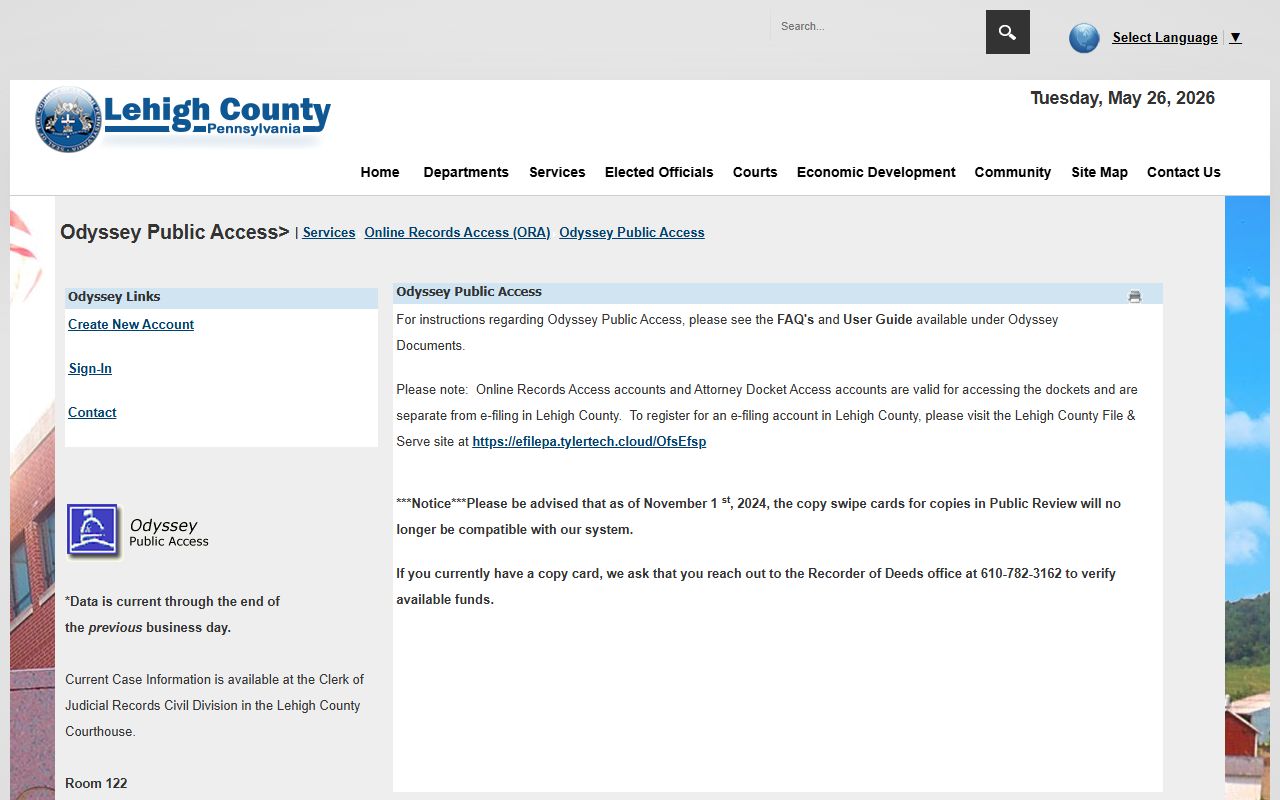
Because that data lags by a business day, the county tells searchers to use the Clerk's office for current case information. The sign-in screen itself sits on a separate county portal.
- Open UJS Case Search and pick a search type, such as docket number or participant name.
- Choose the court type and select Lehigh as the county when you know the case is local.
- Enter a name or docket number, then add a filing-date range to trim common-name results.
- Open the docket sheet from the result to read parties, charges, events, and disposition.
- For pleadings, orders, or certified copies, contact the Clerk of Judicial Records division that holds the file.
You can reach the county sign-in directly at the Lehigh County Odyssey portal, which prompts you to log in or create an account.
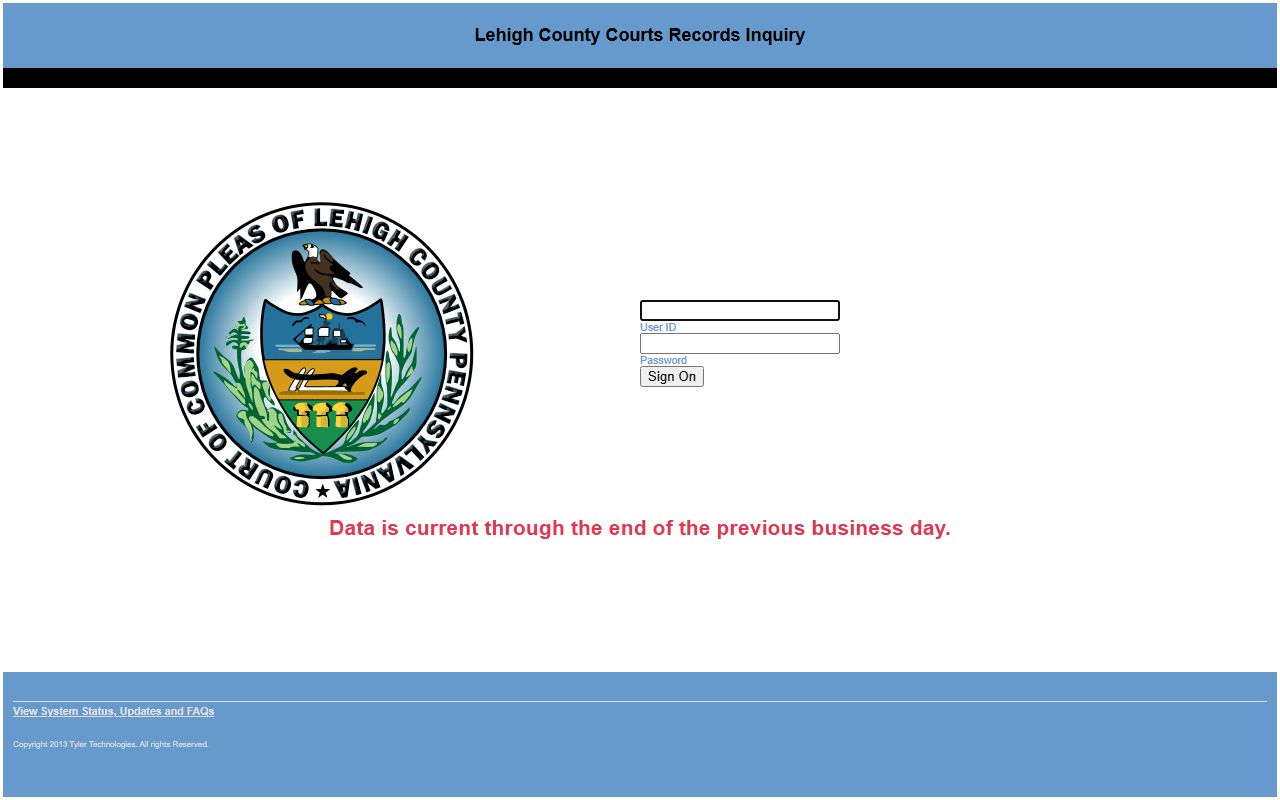
Keep in mind that a UJS docket sheet lists what was filed, but it does not let you download the documents themselves. Those come from the county Clerk.
The UJS portal opens with a set of search fields. The table below shows the main ones and how to use them for a Lehigh County search.
| Field | Type | Required | Notes |
|---|---|---|---|
| Search By | Dropdown | Yes | Docket number, participant name, OTN, citation number, or attorney. |
| Court Type | Dropdown | Yes | Common Pleas, Magisterial District, appellate, or Philadelphia Municipal. |
| County | Dropdown | Helpful | Select Lehigh for local cases. |
| Last / First Name | Text | For name search | Add a date range or year of birth for common names. |
| Docket Number | Text | For docket search | Lehigh Common Pleas criminal dockets use CP-39-CR. |
| Date Filed range | Date | Optional | Narrows large result sets by filing window. |
The Lehigh County Judicial System
Lehigh County is the Thirty-First Judicial District of Pennsylvania. Its trial court of general jurisdiction is the Court of Common Pleas, seated in Allentown. Below that court sit the Magisterial District Courts, the first level of the system. Above it sit two statewide appeals courts and, at the very top, the state Supreme Court.
The Court of Common Pleas runs with ten full-time judges and two senior judges. President Judge Douglas G. Reichley leads the bench. Judges split into a Criminal and Juvenile group, a combined Civil and Family group, and Orphans' Court work. You can view the full roster on the Lehigh County Common Pleas judges page.
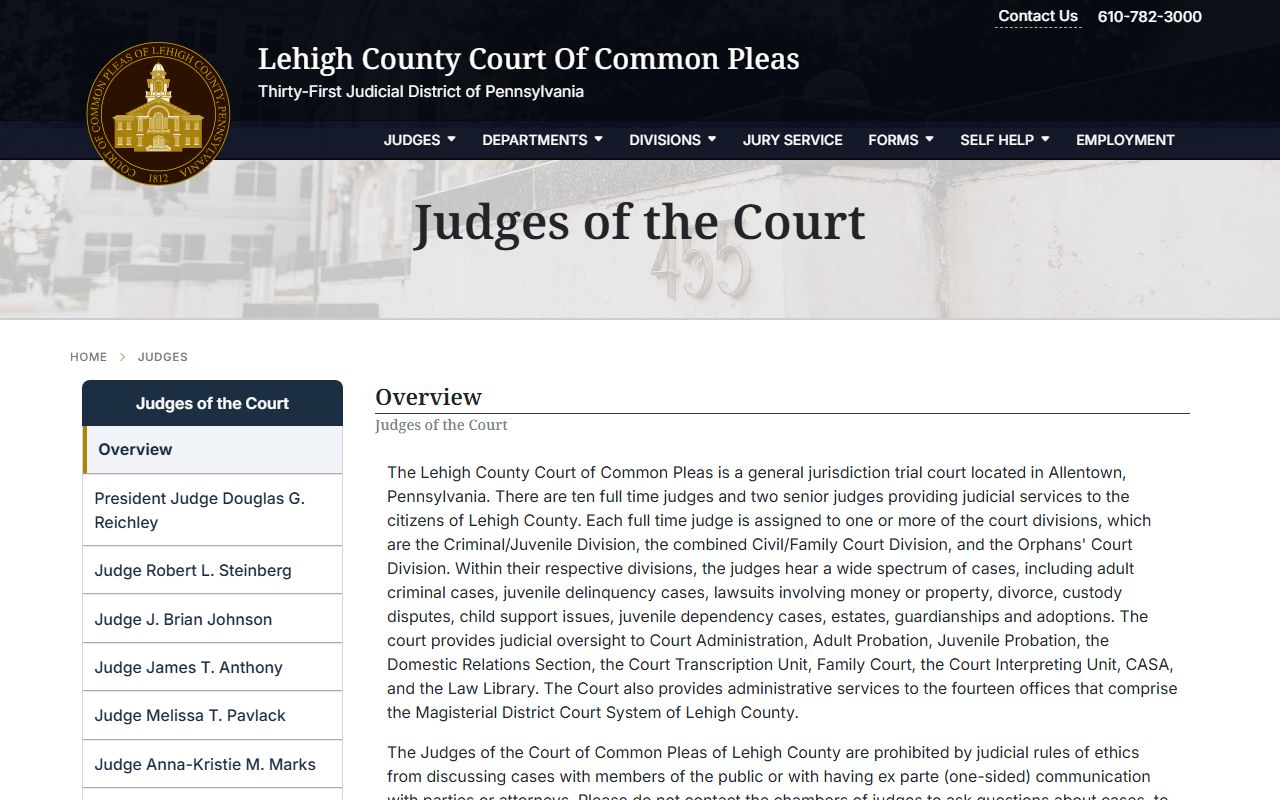
That same court oversees Adult Probation, Juvenile Probation, Domestic Relations, Court Interpreting, CASA, and the Law Library. Judges cannot discuss a case with the public, so any request for action has to come through a proper filing.
Case flow: Magisterial District Court › Court of Common Pleas › Superior Court or Commonwealth Court › Supreme Court of Pennsylvania
| Court | Jurisdiction | Case Types |
|---|---|---|
| Court of Common Pleas | General trial court for the county | Felonies, major civil suits, divorce, custody, support, estates, juvenile |
| Magisterial District Courts | First-level minor judiciary, 14 offices | Summary offenses, most traffic, preliminary hearings, landlord-tenant, civil claims up to $12,000 |
| Superior & Commonwealth Courts | Statewide intermediate appeals | Appeals from Common Pleas decisions |
| Supreme Court of Pennsylvania | Highest state court | Mostly discretionary appeals |
Lehigh County Courthouses
The county court campus is packed into a few downtown Allentown blocks. The main building is the Lehigh County Courthouse on West Hamilton Street, where the Court of Common Pleas and the Clerk of Judicial Records both work. A short walk away stands the Historic Lehigh County Courthouse, still listed as a court location. The court's full contact list, with division phone numbers and security and parking links, sits on the Lehigh County court contact page.
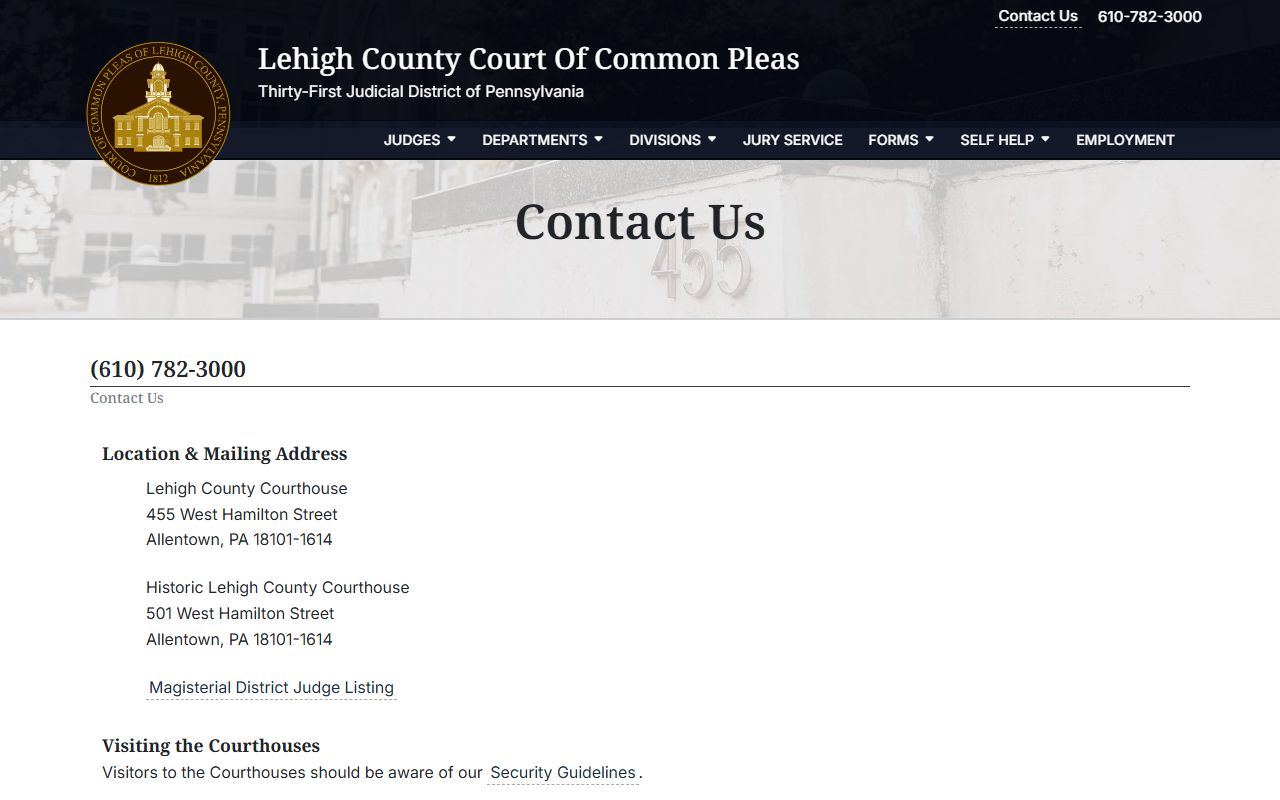
That page is the fastest way to confirm which room or office handles your matter before you drive in. Most records work runs through Room 122.
The records office itself is the consolidated Clerk of Judicial Records. Instead of separate prothonotary, clerk of courts, register of wills, and recorder of deeds offices, Lehigh County folds all four into one elected office with divisions. Its landing page lists the clerk, the address, hours, and links to each division.
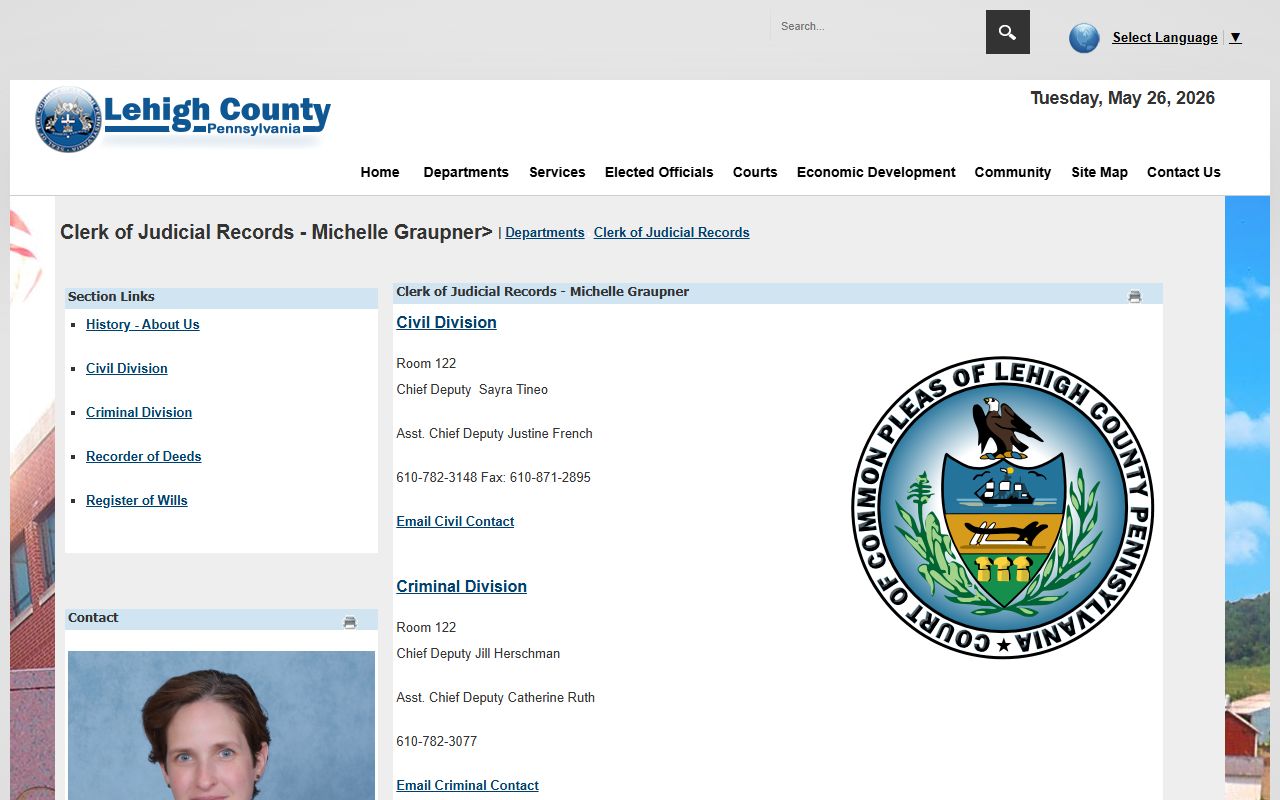
You can reach that office through the Clerk of Judicial Records page, which names the divisions and their direct lines.
Clerk of Judicial Records
455 W. Hamilton Street, Room 122
Allentown, PA 18101-1614
610-782-3148
Historic Lehigh County Courthouse
501 West Hamilton Street
Allentown, PA 18101-1614
(610) 782-3000
Types of Court Records Available in Lehigh County
The county Clerk holds civil, criminal, register of wills, and recorder of deeds records, with coverage that reaches back to the county's start in 1812. Computer coverage is newer. Civil records go back to 1985 online, criminal records to 1990 with index notes to 1962, and register of wills records all the way to 1812. Different divisions create and keep different files.
Most searches fall into one of a handful of record types. Each one is tied to a division or a court level.
- Criminal records - charges, pleas, dispositions, bail, and sentencing for adult and juvenile matters.
- Civil records - lawsuits over money or property, judgments, liens, and arbitration files.
- Family records - divorce, custody, child support, and protection from abuse cases.
- Probate records - wills, estates, guardianships, and adoptions through the Register of Wills and Orphans' Court.
- Traffic records - citations, fines, and dispositions, mostly at the local court level.
What Lehigh County Court Records Show
A docket sheet is a summary of a case. It does not hold the actual documents, but it tells you what the case is, who is in it, and what has happened. The fields below show up on most Lehigh County dockets, whether the case is criminal, civil, or family.
| Field | What It Shows |
|---|---|
| Docket Number | The case ID; Lehigh Common Pleas criminal dockets use CP-39-CR. |
| Filing Date | When the complaint, petition, or appeal was filed. |
| Parties | Names and roles, such as plaintiff, defendant, petitioner, or respondent. |
| Charges / Cause | Statute section and charge grade, or the civil cause of action. |
| Disposition | The outcome, such as dismissed, withdrawn, guilty plea, or judgment. |
| Sentence / Judgment | Any sentence, fine, restitution, or money judgment ordered. |
Some fields stay hidden. Personal identifiers, minors' names, and abuse-victim data are kept off the public view under court policy.
Public Access Laws for Lehigh County Court Records
Pennsylvania starts from a presumption that court records are open, but two different rule sets apply. County agency records, like budgets and contracts, fall under the state Right-to-Know Law. Court case files fall under the Unified Judicial System Case Records Public Access Policy instead. That split matters, because people often send the wrong type of request. You can read the judiciary policy on the UJS public record policies page.
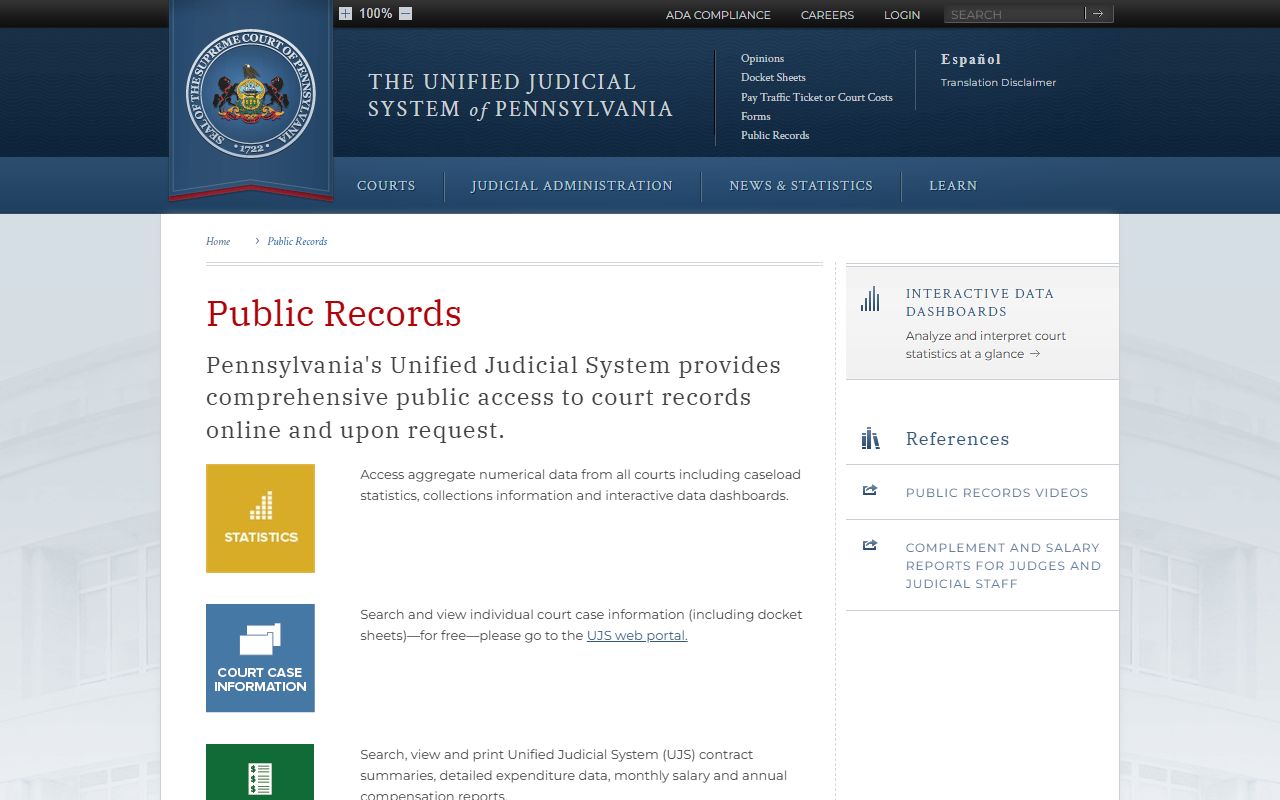
That page also links the docket-sheet search and the forms used to request records or flag confidential information.
Key Statutes:
65 P.S. §§ 67.101-67.3104, Right-to-Know Law - gives the public a right to request agency records, with deadlines and an appeal to the Office of Open Records.
18 Pa.C.S. § 9122 - sets out when a Pennsylvania criminal record may be expunged.
42 Pa.C.S. § 6307 - limits who may inspect juvenile court files.
42 Pa.C.S. § 6308 - controls juvenile law-enforcement records and their release.
Records That Are Restricted or Confidential
The county's own rule is simple to state. Records are public except where the law says otherwise. The Clerk lists the main exceptions by name: juvenile records, child victim records, mental health records, and any case closed by court order. Sealed and expunged matters drop out of the public view too.
Getting access to a closed record is not a search task. It is a legal one. A party, an attorney, or someone with a court order may be able to view a sealed file, but the request goes to the court, not the search portal. For juvenile files, two statutes set the limits, and most members of the public will not have a right to see them.
Specialty Courts and Programs in Lehigh County
The county does run court-adjacent services, even where a formal problem-solving court page was not found. The District Attorney lists a Marijuana Diversion Program, a diversion track for qualifying low-level cases. Treatment-oriented supervision can also show up through the Criminal and Juvenile divisions.
Other support comes from Juvenile Probation, Adult Probation, Domestic Relations, and CASA, all under court oversight. These are not specialty courts, but they shape how many cases move and get supervised. Confirm any program's current rules with the court before you rely on it.
Lehigh County Sheriff and Jail
The Lehigh County Sheriff's Office, led by Sheriff Joseph Hanna, handles civil process, sheriff sales, concealed carry permits, and service of court papers. The county jail is run by Lehigh County Corrections, not by the Sheriff. The jail sits at 38 North Fourth Street in Allentown, a short distance from the courthouse cluster.
For custody, booking, and release questions, the jail's records and general information lines are the right call. For more depth, see Lehigh County inmate records for the roster details, released inmates for verifying a release, and warrant records for how warrant clues show up in court files.
Marriage, Divorce, and Orphans' Court Records
Marriage and estate records run through the Clerk too. The Marriage License Office issues licenses by appointment, and divorce cases live in Family Court records held by the Civil Division. Estate and probate work splits between the Register of Wills and the Orphans' Court. See marriage and divorce records and Orphans' Court records for the full steps and fees.
- Testator
- A person who makes a will.
- Executor
- Someone named in a will to settle the estate.
- Administrator
- Someone the court names to settle an estate when there is no will.
- Intestate
- Dying without a valid will in place.
Lehigh County Court Records Fees
Fees depend on the division and the type of copy. The numbers below are the ones confirmed in official county and state sources. Each Clerk division also posts a full 2026 fee schedule, so check the division page for line-item filing and copy costs before you mail a request.
| Item | Amount |
|---|---|
| Marriage license application (includes two certified copies) | $100 |
| Additional certified marriage copy | $10 each |
| UJS financial-record photocopies (11+ pages) | $0.15 per page |
| UJS financial records on CD | $5 each |
Note: card payments at the Marriage License Office add a 2.9% service fee on top of the listed amount.
How to Interpret Lehigh County Court Records
Court dockets use shorthand. A disposition tells you the result of a charge or claim. A charge is only an accusation, not proof of guilt, so an arrest entry is not the same as a conviction. A docket entry like nolle prosequi means the prosecutor chose not to go forward. Continuance means a hearing was pushed back.
Docket numbers carry meaning too. A CP-39 prefix points to Lehigh Common Pleas, where 39 is the county code. An MJ prefix with a district number points to one of the Magisterial District Courts. When a name search returns more than one match, use the docket number, court level, filing date, or year of birth to be sure you have the right person.
Accuracy and Record Limitations
Online data is not always current. The county's Odyssey Public Access shows information only through the end of the prior business day, so a same-day filing or payment may not appear yet. Very new arrests, sealed cases, and restricted family or juvenile matters may not show at all.
Note: Before you rely on an online record for a job, a lease, or a court matter, confirm the details with the Clerk division that holds the file.
History of Lehigh County Courts
Lehigh County dates to 1812, and its court records run from that year forward. The records office looked very different until recently. Before 1978, the county kept separate offices such as the Clerk of Quarter Sessions and the Prothonotary. A 1978 Home Rule Charter merged some of those roles. Then, in 2008, an amendment abolished and folded the Clerk of Courts, Register of Wills, and Recorder of Deeds into one elected Clerk of Judicial Records. That history is why a single office now answers for civil, criminal, probate, and deed records.
Frequently Asked Questions
How do I search Lehigh County court records online?
Use the free Pennsylvania UJS Case Search for docket sheets and select Lehigh as the county. Pick Court of Common Pleas for felonies, divorce, civil, and estate matters, and Magisterial District Court for traffic, summary offenses, and small claims. Lehigh County also offers Odyssey Public Access, but it needs an account and shows data only through the prior business day.
Can I download court documents from the UJS docket?
No. A UJS docket sheet lists the documents filed in a case, but it does not let you download them. To get pleadings, orders, or certified copies, contact the Clerk of Judicial Records division that holds the file, usually Civil, Criminal, or Register of Wills.
Where is the Clerk of Judicial Records?
The office is in the Lehigh County Courthouse at 455 W. Hamilton Street, Room 122, Allentown, PA 18101-1614. It is open 8:00 a.m. to 4:30 p.m., Monday through Friday, except on major holidays. All four record divisions share Room 122, with a file review area next door.
More on the Lehigh County Court Records FAQ page.