
Pennsylvania Right-to-Know Law and Lehigh County
Pennsylvania's open records law is the Right-to-Know Law (RTKL), 65 P.S. §§ 67.101-67.3104. It starts from a simple idea. Records held by a state or local agency are presumed to be public. That means a Lehigh County agency record is open unless the law says it is not. The RTKL sets deadlines for a response, lets an agency redact or withhold certain content, and gives requesters a right to appeal. Most appeals over local agency records go to the Pennsylvania Office of Open Records. The state Attorney General also keeps a useful Right-to-Know page with general guidance.
Almost anyone can file a request. You do not need to be a resident of the county or the state. You do not have to say why you want the record, though a clear request gets a faster answer. The law defines what counts as a "record," a "public record," and an "agency" under 65 P.S. § 67.102. A record is information that documents a transaction or activity of an agency. Not every piece of paper an office touches is public, and the definitions matter when a request is close to the line.
One point trips up many people. The RTKL is the route for Lehigh County agency records. It is not the main route for court case files. Court records follow the Unified Judicial System (UJS) Case Records Public Access Policy and court rules instead. Send case-file requests to the court or the Clerk, not through a county Right-to-Know request.
What Records the County and the Clerk Keep
Lehigh County records sit in two big buckets. County agencies hold administrative files. The elected Clerk of Judicial Records holds court files. The Clerk's office is its own story. On January 7, 2008, the county merged the old Clerk of Courts, Register of Wills, and Recorder of Deeds into one elected office, the Clerk of Judicial Records. So one office now keeps court case files, probate and estate records, and recorded land documents. For the full case-file picture, see the page on court records and the office profile on the Clerk of Judicial Records.
Common record types people look for in Lehigh County include the following:
- Civil court files: complaints, judgments, liens, and family matters
- Criminal court files, dockets, and dispositions
- Probate, wills, estates, and inheritance-tax filings through Register of Wills
- Recorded deeds and land documents through Recorder of Deeds
- County agency records such as budgets, contracts, and meeting materials
Record coverage runs deep. The county says deed and court records of the Thirty-First Judicial District go back to 1812. Civil computerized records reach back to 1985, and criminal computerized records to 1990, with limited index data to 1962. Older files exist on paper, microfilm, or in docket books and can be viewed in person.
It helps to picture the split before you file. The table below sorts the three main kinds of Lehigh County records and shows where each one goes.
| Record Type | Governed By | Where to Request |
|---|---|---|
| County agency records (budgets, contracts, communications) | Right-to-Know Law, 65 P.S. §§ 67.101-67.3104 | County Open Records Officer |
| Court case records (civil, criminal, family dockets and filings) | UJS Case Records Public Access Policy | Clerk of Judicial Records division that holds the file |
| Restricted records (juvenile, mental health, sealed, child victim) | Statute and court order; closed by law | Not open to ordinary public inspection |
How to File a Public Records Request in Lehigh County
A county Right-to-Know request goes to the Lehigh County Open Records Officer. You can send it by email, by mail, or drop it off in person. Use the county form linked on the county Right-to-Know page. Describe the records with enough detail that staff can find them. A date range, a department name, a subject, names, and any file numbers all help. Pick a format too, such as paper copies or an electronic file. The county explains its Right-to-Know process and posts the request form on its Right-to-Know page.
The county Law Department runs the Right-to-Know intake, and its page lays out the form and the submission routes for a Lehigh County public records request.
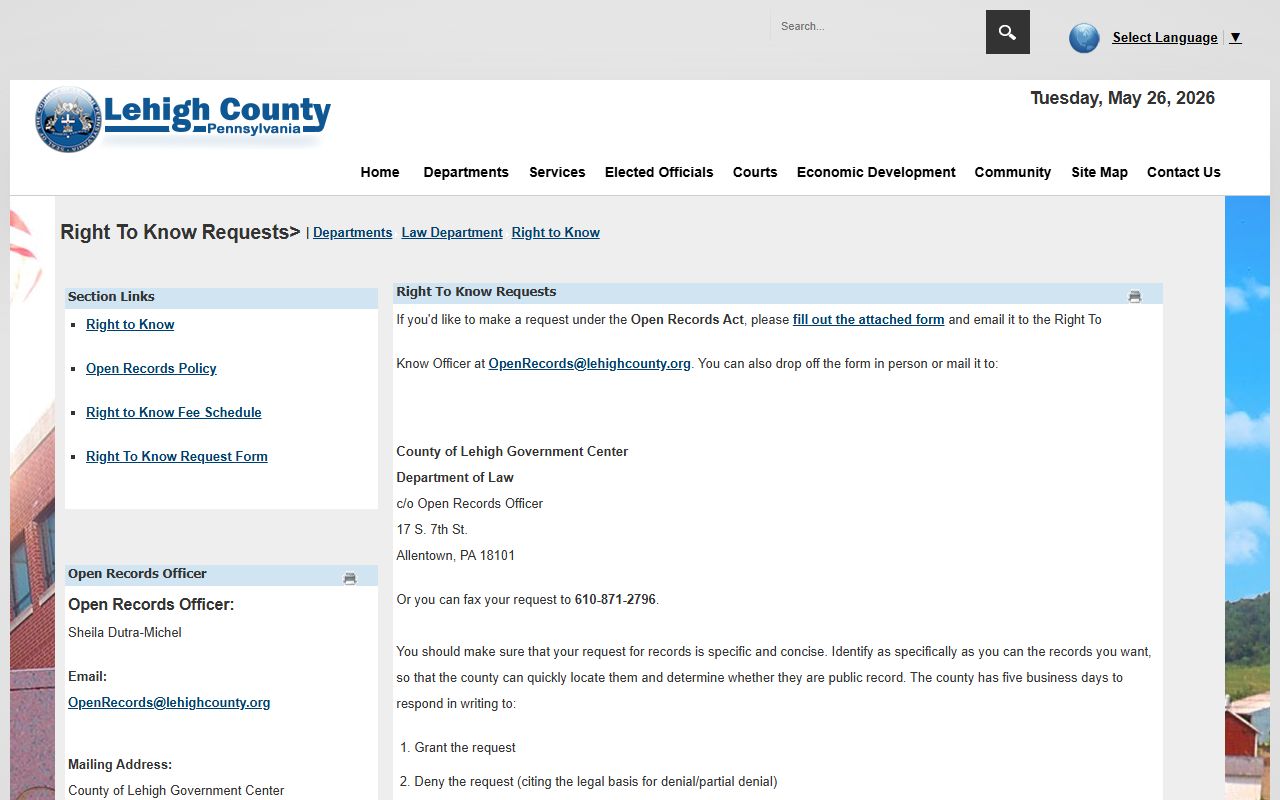
That page names the Open Records Officer and the email, mail, and drop-off options. Follow these steps to file a clean request.
- Decide if the record is a county agency file or a court case file. Use the Right-to-Know route only for county agency records. For case files, contact the Clerk or the court.
- Get the county Right-to-Know form from the county Law Department page.
- Describe the records with care. List a date range, the department, the subject, any names, file numbers, and your preferred format.
- Submit the form. Email it to OpenRecords@lehighcounty.org, mail it to the Open Records Officer, or drop it off at the Government Center.
- Wait for the agency response within the time the law allows. The agency may grant, deny, redact, or ask for an extension.
- Pay any allowed fees, then receive the records. If denied, follow the appeal route stated in the response.
Note: a request for an investigative, privileged, or personal-security record may come back redacted or denied even when the rest of the file is open.
Open Records Officer and Request Form Fields
Every county RTKL request runs through one named officer. For Lehigh County that is Sheila Dutra-Michel. She takes requests by email, by mail, and in person at the Government Center. The contact card below has the details you need to reach the office.
Sheila Dutra-Michel
County of Lehigh Government Center
Department of Law, c/o Open Records Officer
17 S. 7th St.
Allentown, PA 18101
Email: OpenRecords@lehighcounty.org
Accepts email, mail, and in-person drop-off
The county form keeps the request simple. A few fields are required, and the rest help staff pull the right file. The table below lists the core fields and what to put in each one.
| Field | Required | Notes |
|---|---|---|
| Requester Name | Yes | Name and a way to reach you for the response. |
| Description of Records | Yes | Be specific: department, subject, names, and file numbers. |
| Date Range | No | A start and end date trims a broad search. |
| Format Preference | No | Paper copies, electronic file, or in-person inspection. |
Response Timelines for Lehigh County Records
The Right-to-Know Law puts an agency on the clock. After a written request reaches the open records officer, the agency must respond within the statutory time limit or invoke an extension where the law allows one. A response is not always a yes. The agency may grant the request, deny it, or grant part and redact the rest. If the deadline passes with no answer, the law can treat that silence as a denial, which opens the door to an appeal.
The state Attorney General's office offers a plain overview of how Right-to-Know requests and timelines work across Pennsylvania, which lines up with the county process.
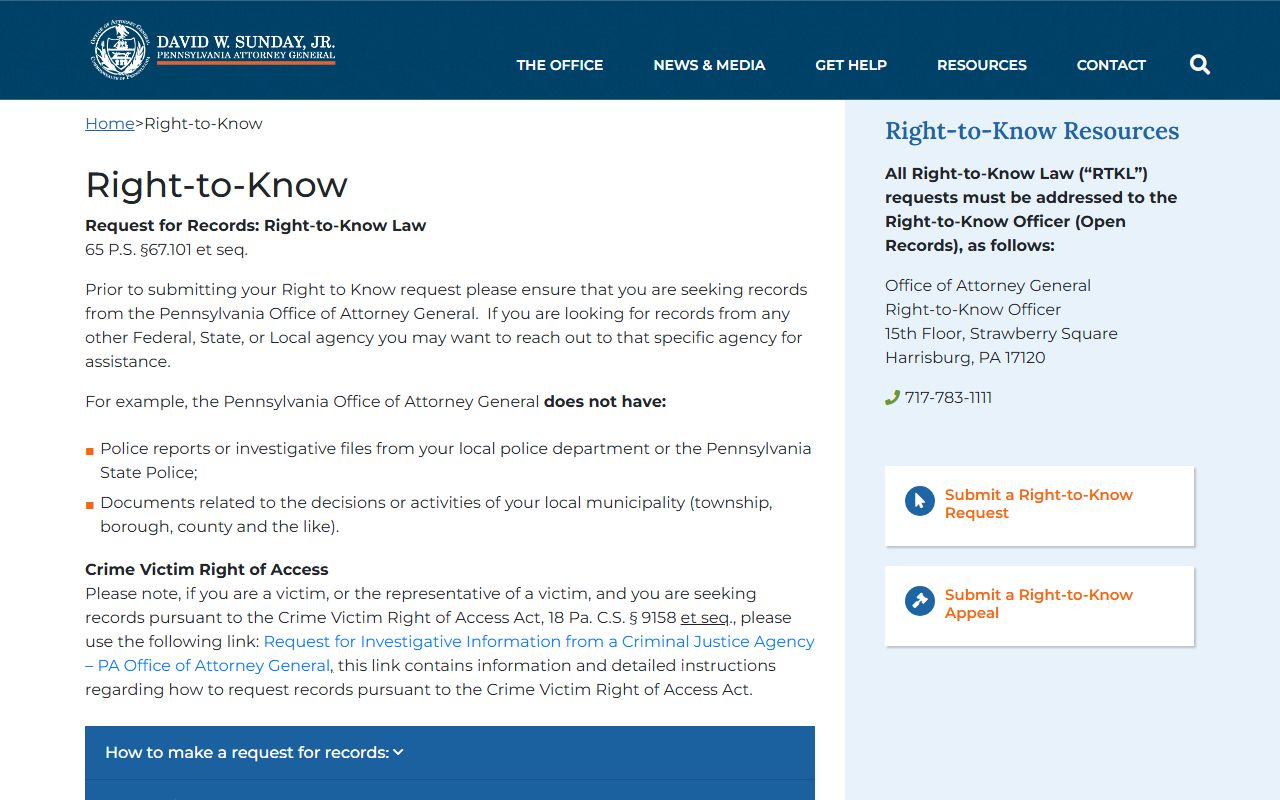
That guidance helps a Lehigh County requester know what to expect after filing and how the appeal track begins. Keep a copy of your request and the date you sent it. Those details matter if you need to appeal later.
Public Records Fees in Lehigh County
Fees depend on the kind of record. For court financial records, the Unified Judicial System posts a set fee schedule. Photocopies run $0.15 per page after the first ten pages. A CD costs $5. You also pay actual postage. County Right-to-Know copy fees are set by the agency and can vary, so confirm the current rate before you submit a county form. The table below shows the UJS financial-record fees.
| Item | Amount |
|---|---|
| Photocopies (after first 10 pages) | $0.15 per page |
| First 10 pages | No per-page charge |
| Records on CD | $5 each |
| Postage | Actual cost |
| County RTKL copy fees | Set by agency; varies |
Note: UJS financial records are a separate category from case records, and the per-page charge only kicks in after the first ten pages.
Records That Are Exempt or Restricted
The Right-to-Know Law does not open every file. Section 67.708 of the act lists the exceptions. A police report, a witness statement, or a prosecutor's file is not public just because it ties to a public case. Records that touch personal security, public safety, medical data, Social Security numbers, or personal identification numbers can be withheld or redacted. Privileged material counts too. Attorney-client communications and attorney work product can apply to county legal records and court-related files alike.
Court records carry their own limits under the UJS Case Records Public Access Policy. The policy starts from openness for case records, but it leaves out judges' notes, drafts, memos, and work product. Several categories sit fully off limits to the public. Lehigh County names juvenile, child victim, and mental health records as precluded by law. Records sealed by court order stay closed as well.
- Juvenile court files and juvenile law-enforcement records (42 Pa.C.S. §§ 6307 and 6308)
- Mental health records and child victim records
- Adoption files and original sealed birth records
- Records closed or sealed by court order
- Criminal investigative records and privileged legal material
This is also where expungement and sealing fit. Under 18 Pa.C.S. § 9122, qualifying criminal history records can be expunged, and Pennsylvania's Clean Slate rules can seal eligible records from public view without destroying them.
If Your Lehigh County Request Is Denied
A denial is not the end of the road. For county agency records, the Right-to-Know Law gives you a right to appeal. Most local-agency appeals go to the Pennsylvania Office of Open Records. The agency's written response should state the appeal route and the deadline, so read it closely. File on time. A late appeal can be tossed no matter how strong the underlying request is.
Court records work differently. The judiciary is not just another county department for Right-to-Know purposes. Court case records follow the UJS Case Records Public Access Policy and court rules, and they have their own appeal and correction steps. If a case file is the issue, raise it with the court or the Clerk of Judicial Records rather than the Office of Open Records. For broader case-search help, the page on court records walks through the docket portals, and the Court of Common Pleas page covers the trial court itself. Common questions land on the FAQ page.