
Lehigh County Court of Common Pleas Overview
The Court of Common Pleas is Pennsylvania's trial court of general jurisdiction. It hears the cases that carry the most weight. Felonies and misdemeanors after bind-over, big civil suits over money or property, divorce, custody, child support, juvenile delinquency, juvenile dependency, estates, guardianships, and adoptions all land here. The court is seated in Allentown, in the Lehigh County Courthouse. Records from this court reach back to the county's start in 1812, with computer records that begin in the 1980s and 1990s. You can run a free statewide docket search through the Pennsylvania UJS Case Search, then ask the county for the file.
Lehigh County is the Thirty-First Judicial District of Pennsylvania. That district line is what ties the local Court of Common Pleas to the statewide system. Searchers often type "Lehigh County district court" out of habit. In Lehigh County, the term most people mean by district court usually points either to the Court of Common Pleas as the county trial court or to one of the Magisterial District Courts for traffic, landlord-tenant, small civil, and preliminary criminal matters. So the name is a bit of a trap, but the records are real and easy to find once you pick the right level.
Lehigh County Court of Common Pleas Judges
The court runs with ten full-time judges and two senior judges. President Judge Douglas G. Reichley leads the bench. Judges are grouped into a Criminal and Juvenile track, a combined Civil and Family track, and Orphans' Court work. One important rule: judges cannot discuss a case with the public, and no party may speak to a judge about a case outside of court without the other side present. That bar on ex parte contact means any request for action must come through a proper filing, not a phone call. The court's official roster is posted on the Lehigh County Common Pleas judges page.
The table below lists the sitting judges and the division or role the court shows for each.
| Judge | Division / Role |
|---|---|
| President Judge Douglas G. Reichley | Criminal Division |
| Robert L. Steinberg | Criminal Division |
| J. Brian Johnson | Civil/Family/Orphans' Court; President Judge Emeritus |
| James T. Anthony | Criminal Division; Supervisory Judge for Grand Jury |
| Melissa T. Pavlack | Civil/Family/Orphans' Court; Administrative Judge of Family Court |
| Anna-Kristie M. Marks | Criminal Division; Administrative Judge of Criminal Division |
| Thomas M. Caffrey | Criminal Division; Administrative Judge of Juvenile Delinquency |
| Thomas A. Capehart | Civil/Family/Orphans' Court; Administrative Judge of Orphans' Court |
| Zachary J. Cohen | Civil/Family/Orphans' Court; Administrative Judge of Civil Division and Juvenile Dependency |
| Mark B. Stanziola | Civil/Family/Orphans' Court; Supervisory Judge for Boards of View and Mortgage Foreclosures |
| Carol K. McGinley | Senior Judge |
| Kelly L. Banach | Senior Judge |
Note: a judge's division can shift over time, so confirm the current assignment with Court Administration before a filing or hearing.
Common Pleas Divisions and Case Types
The Court of Common Pleas splits its work into divisions. The Criminal and Juvenile track handles adult criminal cases and juvenile delinquency. The combined Civil and Family track takes lawsuits over money or property, divorce, custody, child support, and juvenile dependency. Orphans' Court work covers estates, guardianships, and adoptions. The same court provides oversight to a set of support offices, and those offices shape how cases move and get supervised.
Most case types you would search for in Lehigh County fit into one of these tracks. The list below maps the common ones.
- Criminal - felonies and misdemeanors after a preliminary hearing, with pleas, dispositions, and sentencing.
- Civil - money and property suits, judgments, liens, arbitrations, and mortgage foreclosures.
- Family - divorce, custody, child support, and protection from abuse matters.
- Juvenile - delinquency cases and dependency cases involving children.
- Orphans' Court - wills, estates, guardianships, and adoptions, with help from the Orphans' Court and Register of Wills.
Court Administration also oversees Adult Probation, Juvenile Probation, Domestic Relations, Court Interpreting, CASA, and the Law Library. Those offices do not decide cases, but they handle supervision, support enforcement, and access to legal materials.
Lehigh County Magisterial District Courts
The Magisterial District Courts are the first level of the judicial system in Pennsylvania. They are the local minor judiciary, and they handle a high volume of everyday matters. That includes summary offenses, most traffic citations, preliminary hearings in criminal cases, landlord-tenant disputes, civil claims up to $12,000, and emergency protection orders. A criminal case often starts at this level, then moves up to the Court of Common Pleas once charges are held for court. Each office is led by a Magisterial District Judge, sometimes called an MDJ. You can find docket sheets for these courts on the same UJS Case Search portal by choosing the Magisterial District Court level.
Lehigh County reorganized its Magisterial District Court offices effective January 2, 2024. There are fourteen offices across the county. The full table below lists each district, its judge, the office address, and the phone. The court also offers a "Find My MDJ" tool to match an address to the right office, though you should verify the current office with Court Administration, since boundaries and locations can change.
| District | Magisterial District Judge | Address | Phone |
|---|---|---|---|
| 31-1-01 | Linda D. Vega | 1401 W. Green St., Allentown, PA 18102 | 610-432-3080 |
| 31-1-02 | Rashid Santiago | 501 West Hamilton Street, Allentown, PA 18101 | 610-432-8700 |
| 31-1-03 | Ronald S. Manescu | 1428 Hamilton St., Allentown, PA 18102 | 610-434-7903 |
| 31-1-04 | David M. Howells, Jr. | 1501 Lehigh St., Suite 104, Allentown, PA 18103 | 610-797-0906 |
| 31-1-05 | Michael D. D'Amore | 1007 Union Blvd., Allentown, PA 18109 | 610-439-0661 |
| 31-1-06 | Amy Zanelli | 623 W. Union Blvd., Suites 4 & 5, Bethlehem, PA 18018 | 610-691-3950 |
| 31-1-07 | Todd P. Heffelfinger | 3678 Crescent Court East, Whitehall, PA 18052 | 610-437-6096 |
| 31-1-08 | Kyle B. Miller | 2851 South Pike Ave., Suite A, Allentown, PA 18103 | 610-797-8724 |
| 31-1-09 | Mark A. McCants | 413 N. 3rd St., Allentown, PA 18102 | 610-778-5410 |
| 31-2-01 | Karen C. Devine | 501 West Hamilton Street, Allentown, PA 18101 | 610-782-3834 |
| 31-2-02 | Derek A. Kirsopp | 3900 Hamilton Blvd., Suite 101, Allentown, PA 18103 | 610-434-2070 |
| 31-3-01 | Tom Creighton | 106 S. Walnut St., Slatington, PA 18080 | 610-767-8641 |
| 31-3-02 | Michael Faulkner | 5925 Tilghman, Suite 500, Allentown, PA 18104 | 610-398-1167 |
| 31-3-03 | Daniel Trexler | 21 N. Main St., Coopersburg, PA 18036 | 610-282-1555 |
MDJ dockets use an MJ prefix with the district number. Common Pleas criminal dockets, by contrast, use a CP-39 prefix, where 39 is the county code for Lehigh County. That prefix is a quick way to tell which court level a case sits in.
Court of Common Pleas vs. Magisterial District Court
People mix up the two levels all the time. They serve different roles. The Court of Common Pleas is the general trial court for the county. The Magisterial District Court is the local first level. One handles felonies and big civil suits; the other handles summary offenses, small claims, and the early steps of a criminal case. The table below sets the two side by side.
| Court of Common Pleas | Magisterial District Court | |
|---|---|---|
| Role | General jurisdiction trial court for the county | First level, local minor judiciary |
| Civil Limit | No fixed dollar cap; major civil suits | Civil claims up to $12,000 |
| Criminal Jurisdiction | Felonies and misdemeanors after bind-over; trials and sentencing | Summary offenses; preliminary hearings for felonies and misdemeanors |
| Family Cases | Yes - divorce, custody, support, dependency | No - but it can issue emergency protection orders |
| Traffic | Appeals and serious related charges | Most traffic citations and summary traffic matters |
| Other | Estates, guardianships, adoptions, juvenile | Landlord-tenant disputes |
Note: an MDJ decision in a civil or summary case can often be appealed up to the Court of Common Pleas for a fresh hearing.
How a Case Moves Through the System
Cases climb a ladder. Many criminal and small civil matters start at a Magisterial District Court. From there a case can move up to the Court of Common Pleas. A Common Pleas decision can then be appealed to one of two statewide intermediate courts, with the state's highest court at the very top. The basic path looks like this:
Court flow: Magisterial District Court › Court of Common Pleas › Superior Court or Commonwealth Court › Supreme Court of Pennsylvania
The choice between the two appeals courts depends on the subject. Most criminal, civil, family, and Orphans' Court appeals from the Court of Common Pleas go to the Superior Court of Pennsylvania. Cases that involve government agencies, the public sector, or Commonwealth matters go to the Commonwealth Court of Pennsylvania instead. The Supreme Court of Pennsylvania sits at the top and takes mostly discretionary appeals.
- A summary, traffic, or small civil matter is filed or cited into a Magisterial District Court, where it may be decided or held for court.
- Felony and major civil matters proceed to the Court of Common Pleas for trial, hearing, and judgment.
- A party who loses at Common Pleas may appeal to the Superior Court or the Commonwealth Court, based on the subject.
- The Supreme Court of Pennsylvania may grant review of an appellate ruling, but it is not required to.
Federal Court for Lehigh County
Not every case in the county is a county case. Federal matters are handled by a separate court system, and the Lehigh County Courthouse does not handle them at all. Lehigh County falls within the U.S. District Court for the Eastern District of Pennsylvania. That federal district keeps courthouses in Philadelphia, Allentown, Reading, and Easton, with Clerk's Offices in Philadelphia and Allentown. The Allentown federal courthouse is the Edward N. Cahn U.S. Courthouse at 504 W. Hamilton Street, just a short walk from the county courthouse cluster. Federal cases include federal crimes, civil rights claims, federal-question and diversity suits, and cases where the United States is a party.
The Eastern District's main site is the place to start for federal procedures, local rules, and contact details.
You can review the court's home page through the U.S. District Court for the Eastern District of Pennsylvania website.
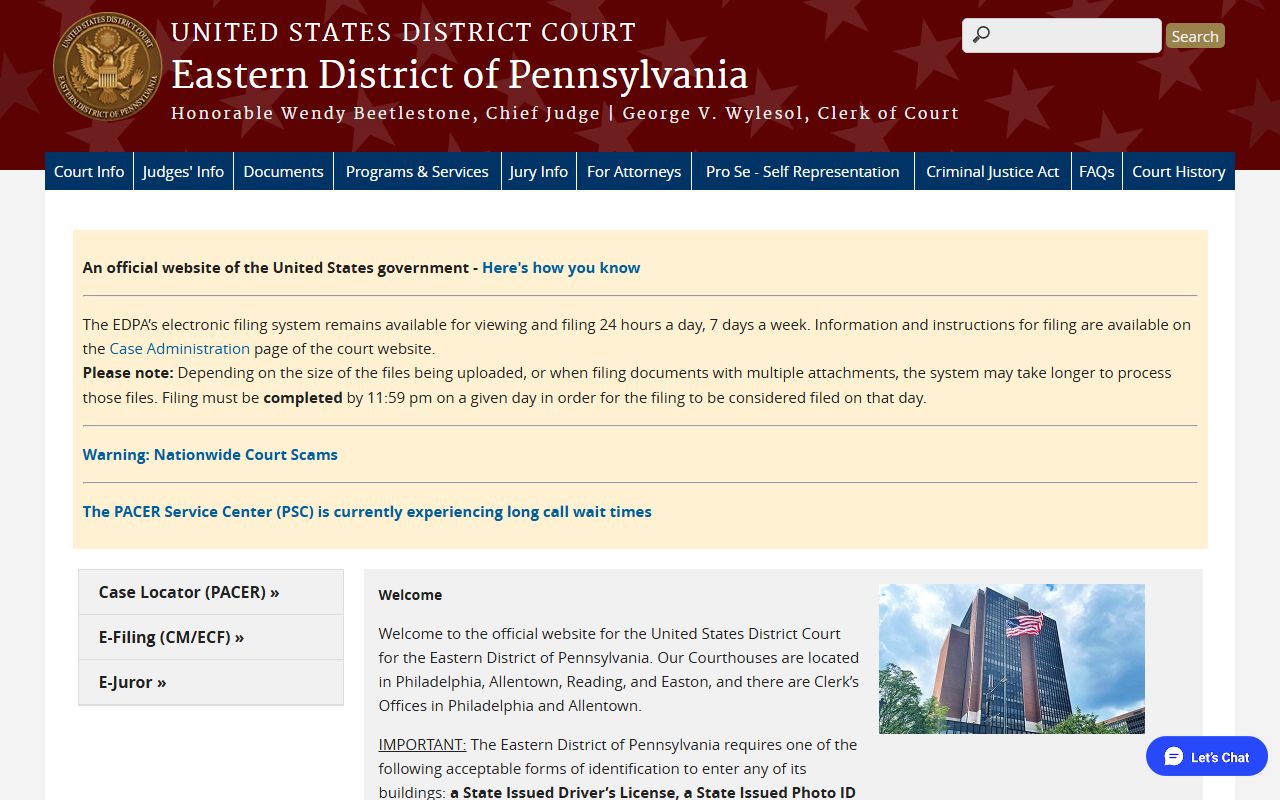
That site explains where each courthouse sits and which Clerk's Office to call, which matters because Allentown handles cases from this end of the district. For records, federal courts do not use the state UJS portal. They use a national system called PACER.
PACER, short for Public Access to Court Electronic Records, is the federal record system. It runs on per-page access fees and needs a registered account. To confirm that the Eastern District is the right court before you log in, use the PACER court lookup.
You can verify the court code through the PACER CM/ECF court lookup for the Eastern District of Pennsylvania.
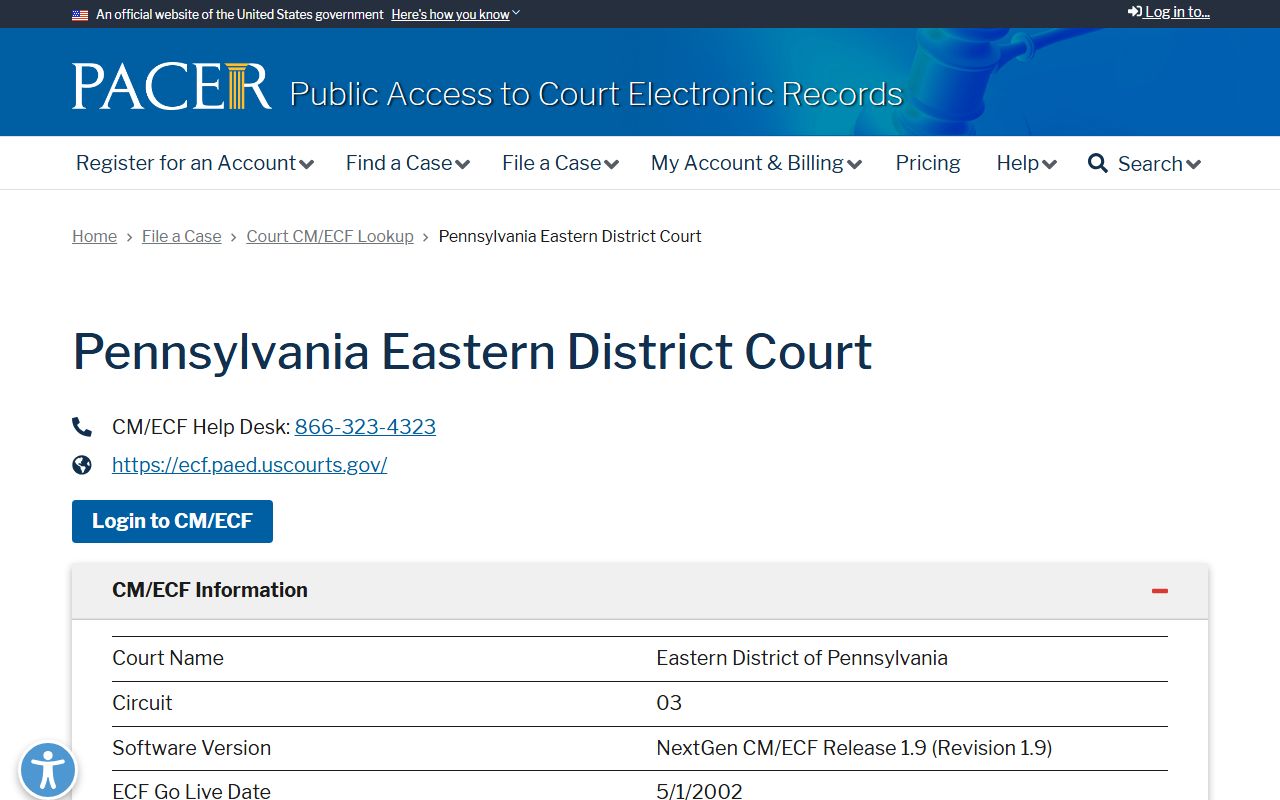
The lookup confirms the right access point so you are not searching the wrong district. Filing itself runs through a related system called CM/ECF, which the Eastern District now uses in its NextGen form.
Attorneys and some pro se filers register for the court's electronic filing platform before they can submit documents. The Eastern District posts its NextGen setup steps online.
You can read the filing steps on the Eastern District NextGen CM/ECF page.
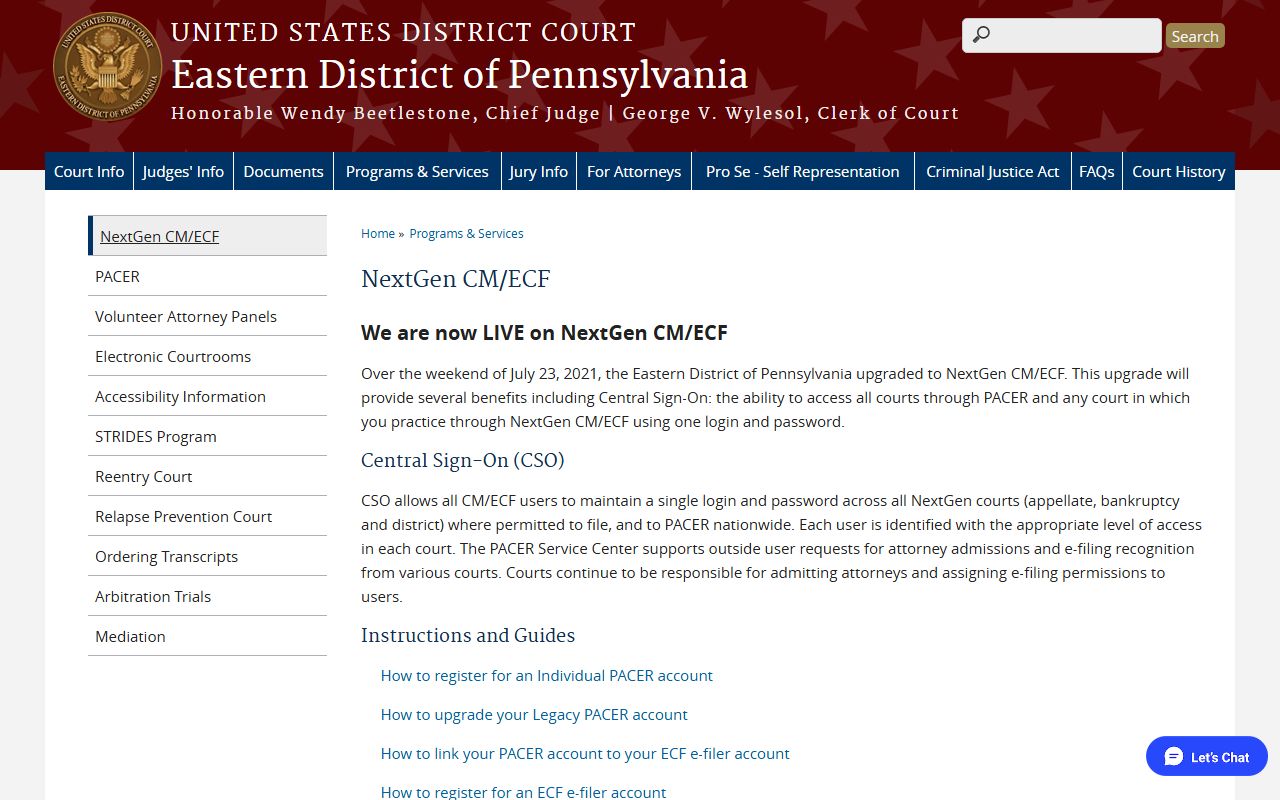
That page walks filers through linking a PACER account to a filing account. Bankruptcy is its own branch of the federal system, handled by a separate court.
Federal bankruptcy matters from Lehigh County go to the bankruptcy court for the Eastern District of Pennsylvania, not to the county or the regular district court. It keeps its own dockets, forms, and filing rules.
You can reach it through the U.S. Bankruptcy Court for the Eastern District of Pennsylvania website.
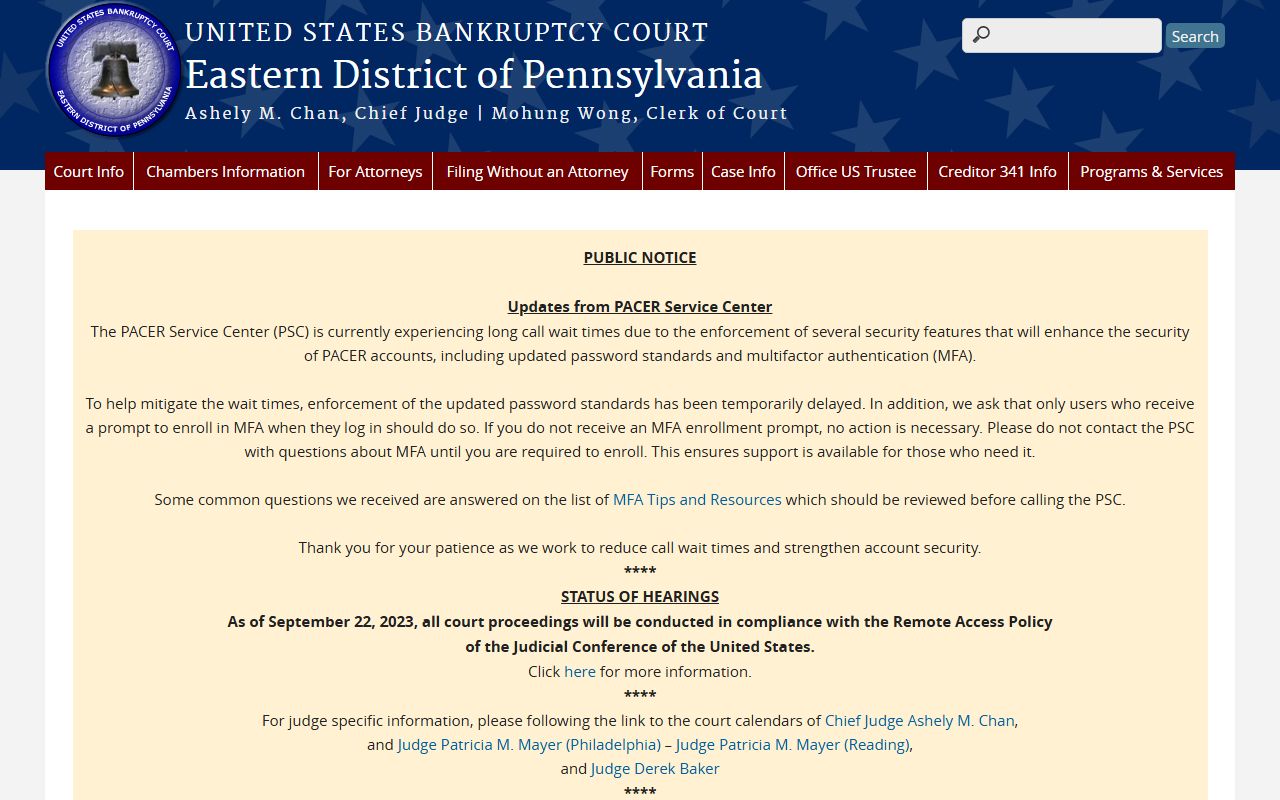
The U.S. Attorney for the district is David Metcalf, whose office covers Lehigh and eight nearby counties from offices in Philadelphia and Allentown. Federal appeals from the district go to the U.S. Court of Appeals for the Third Circuit, a separate court from the state appeals courts.
How to Find a Lehigh County Common Pleas Case
Two official systems hold most of what you need for a county case. The free one is the statewide UJS Case Search, which shows docket sheets. The county one is Lehigh County Odyssey Public Access, which needs an account and shows data only through the end of the prior business day. Start with the free portal to locate a case, then use the county for documents and same-day status. A docket sheet lists what was filed, but it does not let you download the documents themselves.
For pleadings, orders, and certified copies, the file lives with the consolidated Clerk of Judicial Records. You can also look up case histories through the broader Lehigh County court records guide, browse the court dockets page for what a docket holds, or check traffic court records for citations that start at the local court level. The county's own online access tool sits on the Lehigh County Online Records Access page.
Note: e-filing is mandatory for most civil case types and for family, Register of Wills, and Orphans' Court types, with limited exemptions, so many filers use the state e-filing system rather than mailing paper.