
Arrest Records in Lehigh County
An arrest record is made when a person is taken into custody. In Lehigh County, that arrest can come from a local police department, the Lehigh County Sheriff's Office under Sheriff Joseph Hanna, a warrant officer, or another agency. The record marks the start of the process. It is not a finding of guilt. A typical arrest record names the person, gives the date and place of arrest, lists the charge or charges, and notes the agency that made the arrest. If the person is held, a jail booking record is created next at intake.
People treat "arrest records" as one thing, but really there are several. The police arrest report is one file. The jail booking and custody record is a second. The criminal court docket is a third. A statewide criminal history kept by the Pennsylvania State Police is a fourth. The final court disposition is yet another. Different agencies hold each one. Arrest records are the focus here. For the full court file, charges, motions, and the outcome of a case, see Lehigh County court records and the docket-level view on the court dockets page.
Charge is not conviction. An arrest means someone was accused, not that a court has ruled.
How to Search Lehigh County Arrest Records
There is no single button that pulls "all arrest records." You search the right office for the record you actually want. To confirm someone is in custody right now, you call the jail. To read the charges and court events tied to an arrest, you use the free Pennsylvania Unified Judicial System (UJS) Case Search, which posts docket sheets for Common Pleas and Magisterial District cases. To get a formal statewide criminal history, you go through the Pennsylvania State Police. Each route answers a different question, so pick by what you need to know.
- For current custody, call Lehigh County Jail records at 610-782-3263 or general information at 610-782-3270 to verify a booking.
- Open UJS Case Search and look up the person by name or docket number to read charges and court events.
- Pick the court type and select Lehigh as the county, then add a filing-date range to trim common-name results.
- For a certified criminal court file, contact the Clerk of Judicial Records Criminal Division at 610-782-3077.
- For a formal statewide criminal history check, use the Pennsylvania State Police process rather than a county office.
The county also hosts Odyssey Public Access, which needs an account and shows data only through the end of the prior business day. For same-day status, the county points searchers to Room 122 during office hours.
Arrest Records vs. Criminal Court Records
An arrest record is built at the moment of arrest and booking. A criminal court record begins later, once charges are filed and a case opens. In Pennsylvania, many criminal cases start at the Magisterial District Court level with a complaint, preliminary arraignment, bail, and a preliminary hearing. If the charges are held for court, the case moves up to the Court of Common Pleas. The arrest record and the court record describe the same event, but they live in different systems and serve different purposes.
| Arrest Record | Criminal Court Record | |
|---|---|---|
| Source | Police, sheriff, or arresting agency; jail at booking | Clerk of Judicial Records Criminal Division and the courts |
| Created When | At arrest and intake booking | When charges are filed and a case opens |
| Contents | Booking info, charges, arresting agency, custody status | Pleadings, charges, hearings, pleas, disposition, sentence |
| How to Access | Jail records phone; police report request | UJS Case Search docket; certified copies from the Clerk |
For the full case history behind any arrest, the court file is the better source. The court records page covers how that file is read and requested.
Charges vs. Convictions
This is the most common mistake people make when they read an arrest record. A charge is an accusation. A conviction is a result. An arrest only means a charge was brought. The person may later plead guilty, be found guilty, have the charge dropped, be found not guilty, or have the case dismissed. None of that is known at the arrest stage. Reading a charge as if it were a conviction is both unfair and, in some settings, against the law.
| Charge | Conviction | |
|---|---|---|
| Stage | Accusation at or after arrest | Verdict or guilty plea |
| Burden of Proof | Probable cause | Beyond a reasonable doubt |
| Where It Shows | Arrest record, booking, early docket | Final disposition on the court docket |
| Meaning | The case is still open or unresolved | The court has entered a final result |
A docket sheet on UJS can show charges, statute sections, grades, the offense tracking number (OTN), proceedings, bail, and the final disposition. Always read down to the disposition before you draw a conclusion. The outcome, not the arrest, is what tells the real story.
The District Attorney and Public Defender
Two offices sit on opposite sides of a Lehigh County criminal case. The District Attorney prosecutes. The Public Defender represents people who cannot afford a private lawyer. Neither office runs a public arrest-records search, but both deal with the case files that arrest records turn into, so they come up often when people look into a charge.
The Lehigh County District Attorney is Gavin P. Holihan. The office and its units are described on the District Attorney department page.
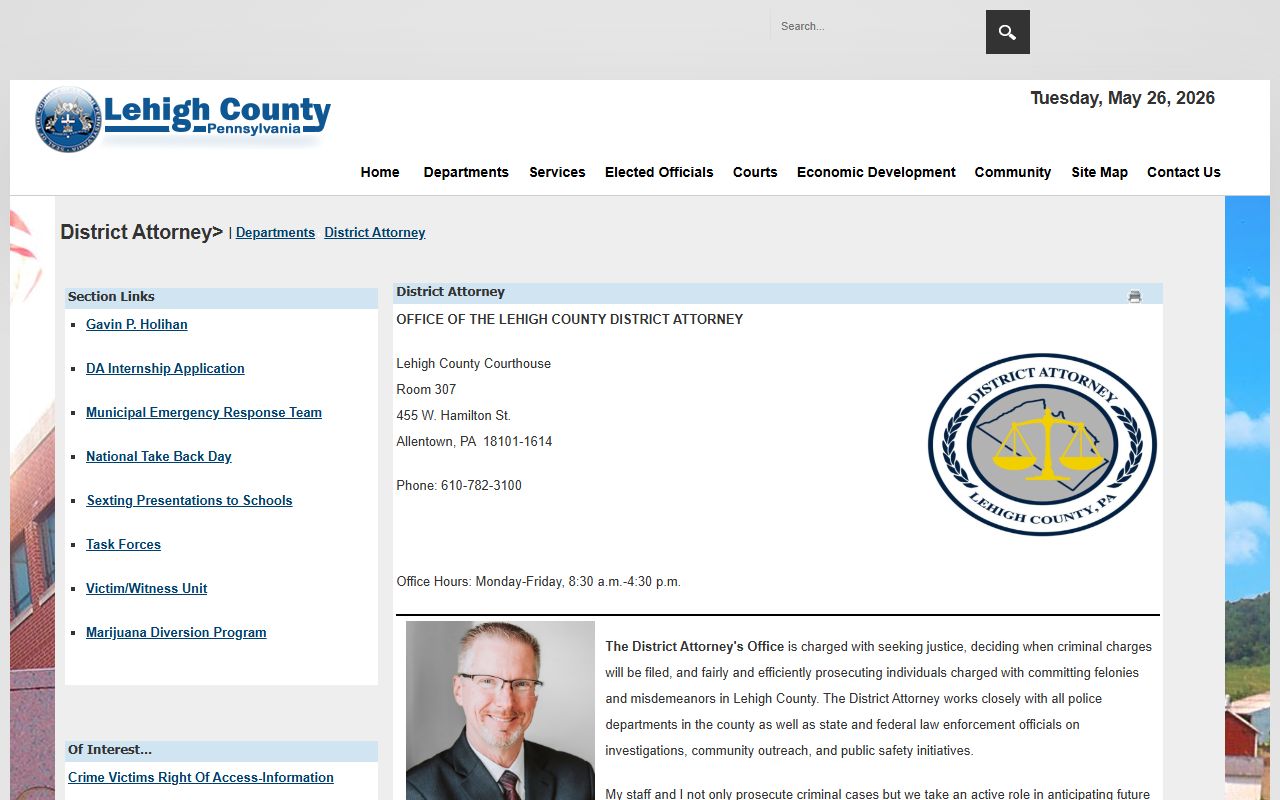
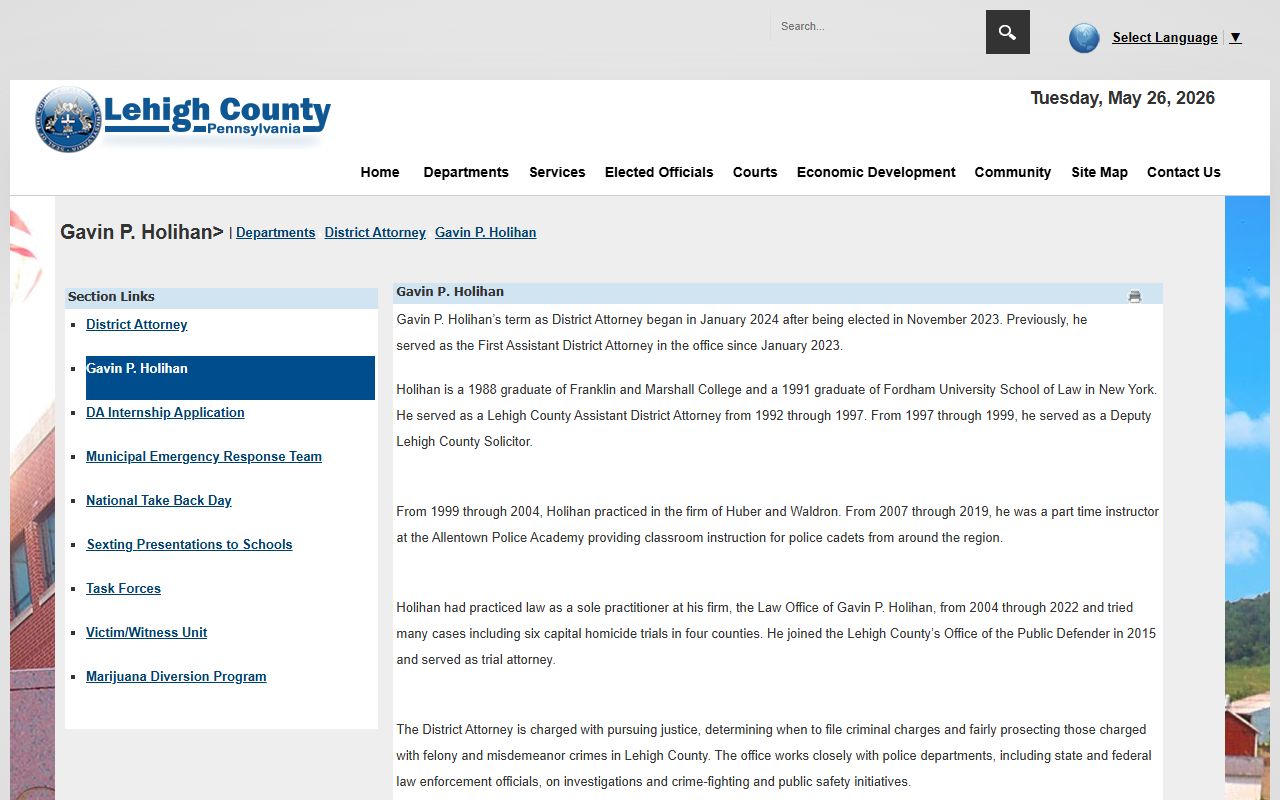
That same office runs task forces, school programs, and a Victim/Witness Unit. The DA's Gavin P. Holihan bio page gives the background of the elected prosecutor who leads it.
Victims and witnesses in a criminal case get help from a dedicated unit. The Victim/Witness Unit page describes its services.
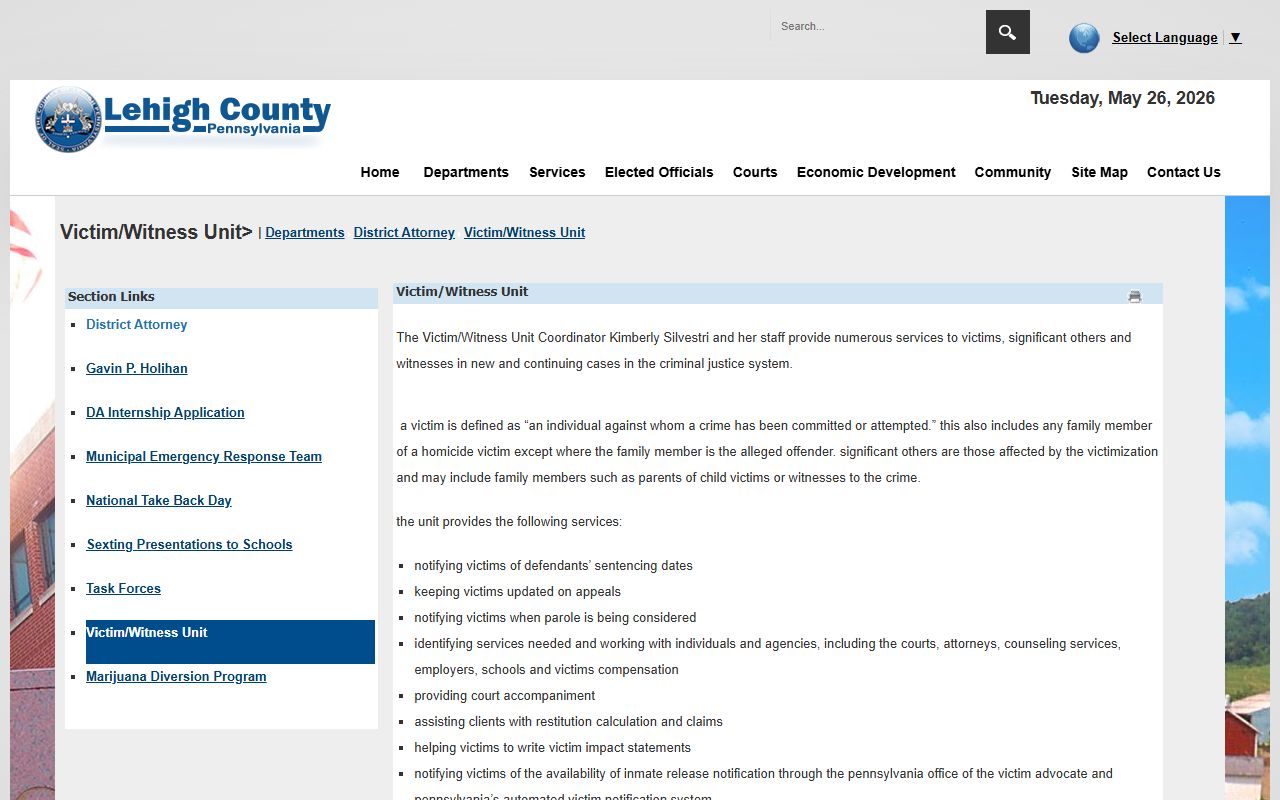
The unit, led by coordinator Kimberly Silvestri, notifies victims of sentencing dates, helps with restitution and victim impact statements, offers court accompaniment, and explains PA SAVIN notifications. It keeps a separate, safe waiting area and added a courthouse companion dog named Ramona in 2017.
Lehigh County Public Defender
People who are arrested and cannot pay for a lawyer can apply for the Public Defender. The office handles adult criminal and juvenile matters and links resources that explain the Pennsylvania criminal court system. You can read more on the Public Defender department page.
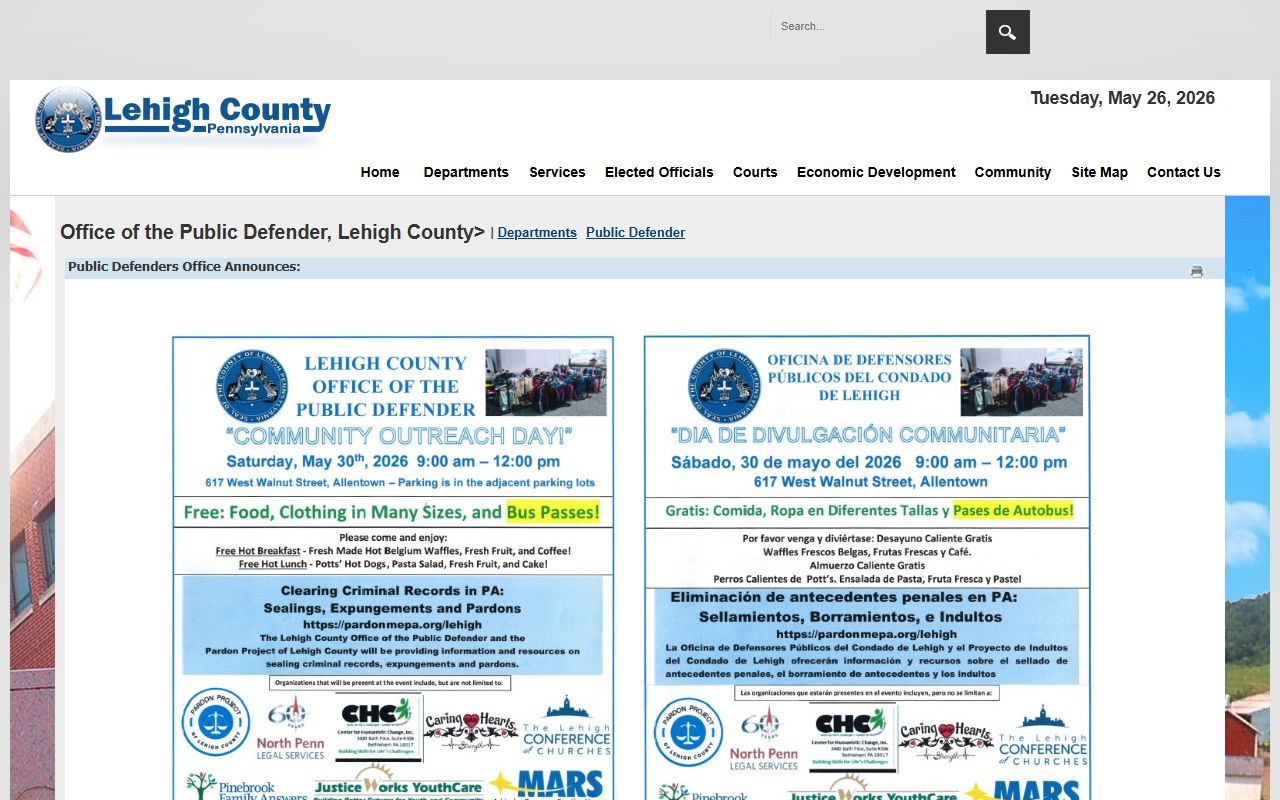
Applications are linked in English and Spanish, and the office asks people to allow five to seven business days for processing. The contact details are below.
Office of the Public Defender
Lehigh County Courthouse, Room 615
455 Hamilton Street, Allentown, PA 18101-1602
610-782-3157
Fax 610-820-3154
GeneralPublicDefender@LehighCounty.org
Mon-Fri 8:00 a.m.-4:30 p.m.
Note: the office did not publish full income or asset limits in this research, so confirm eligibility on the application before you assume you qualify.
The Marijuana Diversion Program
Not every arrest ends in a standard prosecution. The District Attorney runs a Marijuana Diversion Program, a DA-led path that can route eligible cases away from the usual track. It is best treated as a diversion initiative of the prosecutor's office rather than a court-supervised specialty court. Details and criteria are on the official Marijuana Diversion Program page.
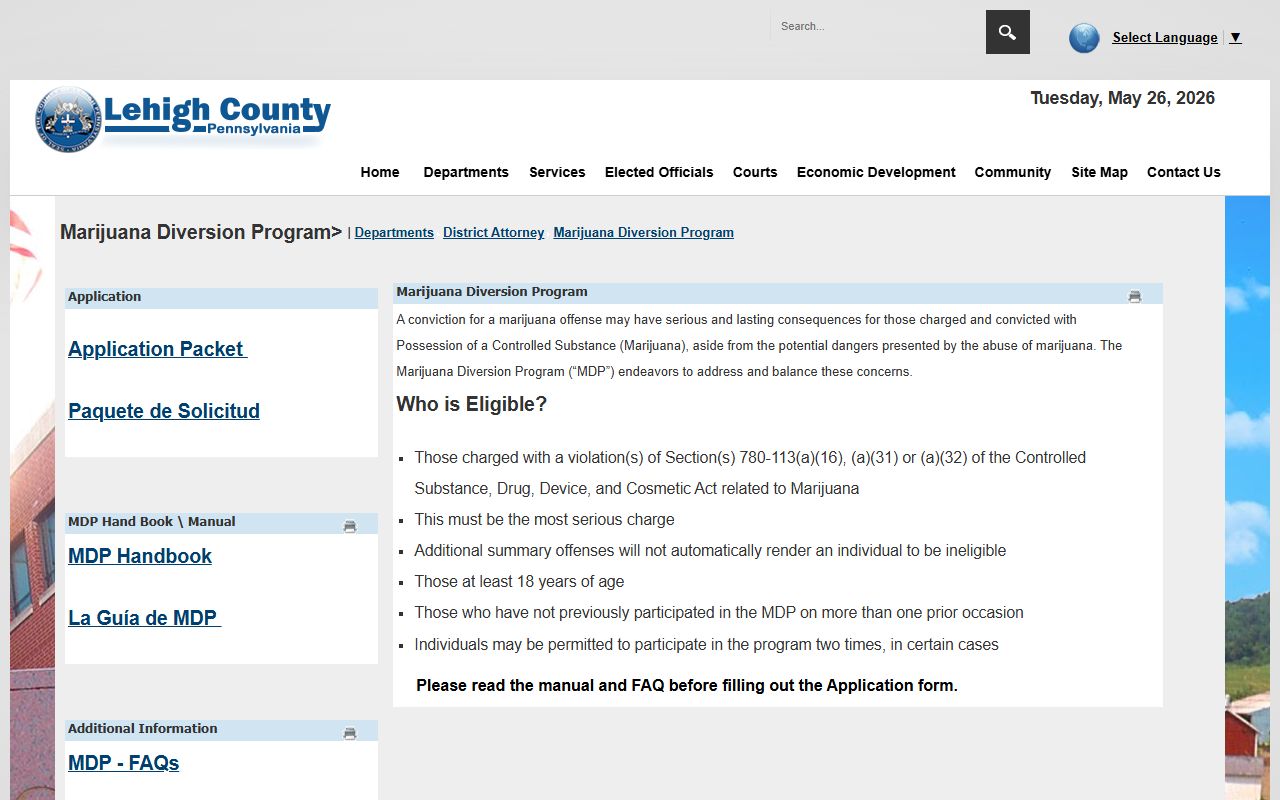
Why this matters for records: completing a diversion or program can change what later shows up. Successful completion of a diversion program is one of the situations that can make a record eligible for expungement down the road. The exact rules sit with the DA and the court, not with any outside site.
Mugshots, Booking, and the Jail Roster
People often expect a county website with mugshots and a live arrest list. Lehigh County does not work that way. No official county jail roster or public mugshot list was found for the Lehigh County Jail in this research. The jail is run under Lehigh County Corrections, and it shares records and general information by phone rather than through an online roster. Be careful with third-party "mugshot" sites, which are not official and are not used here.
The booking flow follows a standard pattern. After an arrest, a person who must be held is transported to intake at the county jail. Staff handle identification, booking records, a property inventory, medical and mental health screening, and housing classification. Bail or arraignment status is then set by a Magisterial District Judge or by the Court of Common Pleas, depending on the stage of the case. Release can follow posting bail, a court order, the end of a sentence, a transfer, or other authority.
To confirm a current booking, the jail is the right source.
Lehigh County Jail
38 North Fourth Street
Allentown, PA 18102
Records: 610-782-3263
General information: 610-782-3270
Warden Jeffrey R. Smith
To find out whether someone is currently held, use the Lehigh County inmate records page, which covers custody verification and notification tools in more depth.
Bail and the Criminal Division
Once charges are filed, the Clerk of Judicial Records Criminal Division becomes the hub for the criminal court file. The division maintains criminal court records, processes adult and juvenile criminal matters, keeps bail-bond agency records, issues and distributes refunds, and accepts appeals. It also handles bail money. One local detail matters here: the Criminal Division collects cash only for monetary bail.
Clerk of Judicial Records, Criminal Division
Lehigh County Courthouse, Room 122
455 W. Hamilton Street, Allentown, PA 18101-1614
610-782-3077
Mon-Fri 8:00 a.m.-4:30 p.m.
If a case has an open warrant or a missed court date, contact the issuing Magisterial District Court or the Criminal Division. The neutral path is to identify the issuing court and resolve the matter through proper channels, and to confirm the docket later, since online systems can lag. For more on this, see warrant records.
Statewide Criminal History Through PSP
A county arrest record is local. A statewide criminal history is different, and it does not come from the county clerk. In Pennsylvania, the formal statewide criminal history is handled by the Pennsylvania State Police, often through its PATCH system. This is the file most often pulled for background purposes, and it draws on records from across the Commonwealth, not just one county.
Keep these separate in your mind. A police arrest report, a jail booking record, a criminal court docket, a PSP criminal history, and a final court disposition are five distinct records from different agencies. A name match on one does not prove anything on another. For employment, licensing, or legal use, a certified disposition or an official PSP criminal history is the right document, not a casual lookup.
Sealed vs. Expunged Records
Pennsylvania gives two main ways to limit who can see an old record, and they are not the same. Expungement removes a qualifying record from criminal history access, subject to narrow exceptions for law enforcement and court officials. Limited access, the Clean Slate path, seals an eligible record from most public searches without destroying it. One erases. The other hides. Expungement is governed mainly by 18 Pa.C.S. § 9122.
| Sealed (Limited Access) | Expunged | |
|---|---|---|
| Visibility | Hidden from most public searches | Removed from criminal history access |
| Law Enforcement | Still available to criminal justice agencies | Very limited access; courts and law enforcement excepted |
| Eligibility | Qualifying records under Clean Slate / limited-access rules | Summary offenses after waiting periods, non-convictions, diversion completion, pardons, certain age and conviction categories |
| Scope | Pennsylvania records | Pennsylvania records only; not federal or out-of-state |
The Pennsylvania State Police expungement page is clear that expungement affects Pennsylvania arrests and convictions only. It does not reach federal cases, out-of-state cases, or private copies someone already obtained outside the official repositories. You can read the state process on the PSP expungement page.
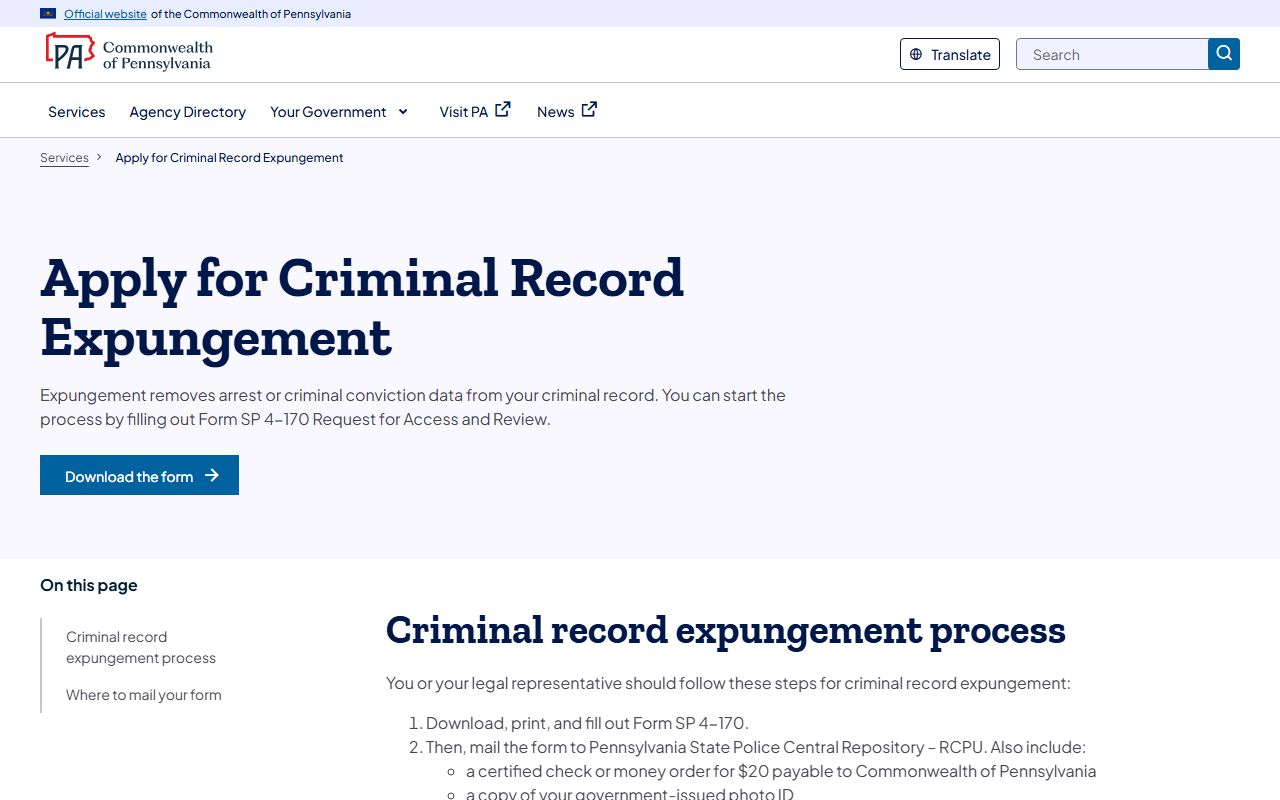
That page lays out the basic idea, and the steps below show how a Lehigh County petition usually moves.
How Expungement Works in Lehigh County
Expungement is not a general eraser for every conviction. It is a statutory remedy for eligible categories only. People who want it generally need the docket number, the OTN, the court of record, the final disposition, and any petition and order forms the county and state require. The process runs through the court that held the case, not through an outside service.
- Confirm the record is eligible under 18 Pa.C.S. § 9122 and gather the docket number, OTN, and final disposition.
- File the petition in the court of record, which for a Lehigh County case is the Court of Common Pleas through the Criminal Division.
- Serve the required agencies, including the District Attorney and the Pennsylvania State Police.
- Obtain a signed court order if the petition is granted.
- The Clerk transmits the order to the State Police and central repositories so the record is removed from criminal history access.
Petitions get denied for predictable reasons. Common ones include a non-eligible offense, unpaid court obligations, a new arrest or conviction during a waiting period, an incorrect docket or OTN, missing service on the DA or PSP, or trying to expunge a federal or out-of-state matter in a Pennsylvania county court. Note: many people use the Public Defender or a private attorney to prepare an expungement petition because a small error can sink the request.
Background Check Considerations
There is a real line between a casual lookup and a regulated background check. If a record is used to decide on a job, an apartment, credit, or insurance, the Fair Credit Reporting Act sets rules, and the report must come from a regulated source. A quick name search on a free docket portal is not that. Treat what you find as a starting point and confirm it against an official, certified source before you act on it.
Important: This site is not a consumer reporting agency under the FCRA, and its results may not be used for employment, tenant, credit, insurance, or other FCRA-regulated decisions.
Restricted Criminal Records in Lehigh County
Not all arrest and criminal records are open. Pennsylvania law and Unified Judicial System policy wall off several categories from ordinary public access. Juvenile records are the biggest one. Juvenile court files and law-enforcement records tied to minors are governed separately, and ordinary public lookup is restricted under 42 Pa.C.S. § 6307 and 42 Pa.C.S. § 6308. Some juvenile information may reach courts, counsel, agencies, schools, or law enforcement in limited cases, but not the general public.
Other records are restricted too. The list below covers the main ones that you will not find through a normal search.
- Juvenile delinquency and dependency files.
- Child victim records and abuse-victim information.
- Mental health records, which are precluded by law.
- Adoption records and sealed original birth records.
- Cases or documents sealed by court order.
- Active criminal investigative files held by police or the DA.
A few quick definitions help when these terms show up on a record or a docket.
- OTN
- Offense tracking number, the identifier that ties a charge across Pennsylvania criminal records.
- Disposition
- The outcome of a charge or case, such as dismissed, guilty plea, or sentence imposed.
- Sealed record
- A record closed from ordinary public inspection by law or court order.
- Expungement
- The legal removal of a qualifying record from criminal history access.
Note: a docket can lag or hold limited information, and same-day filings, sealed cases, and expunged matters may not show up at all.