
What Orphans' Court Covers in Lehigh County
Probate is the legal step that proves a will and settles what a person left behind. In Lehigh County, that work splits across two offices. The Register of Wills Division opens the estate and handles probate and inheritance-tax filings for people who have died. The Orphans' Court Division of the Court of Common Pleas takes the matters that need a judge. It hears estates, guardianships, adoptions, and trusts. It also handles contested estates and any case that needs court supervision or a ruling.
The Orphans' Court reaches beyond simple wills. It can name a guardian for a person who cannot manage money or care for themselves. It can confirm a fiduciary's account. It can decide a fight between heirs. A short list of common Orphans' Court matters helps show the range.
- Wills and probate petitions.
- Estate administration and inheritance tax.
- Letters testamentary and letters of administration.
- Inventories and accounts filed by a fiduciary.
- Guardianships of incapacitated persons and minors.
- Trusts and appeals from Register of Wills actions.
The official Orphans' Court page states that the Clerk of Orphans' Court is the custodian of all Orphans' Court records and runs the daily work of the office. You can read more on the Lehigh County Orphans' Court page, which lays out what the division does.
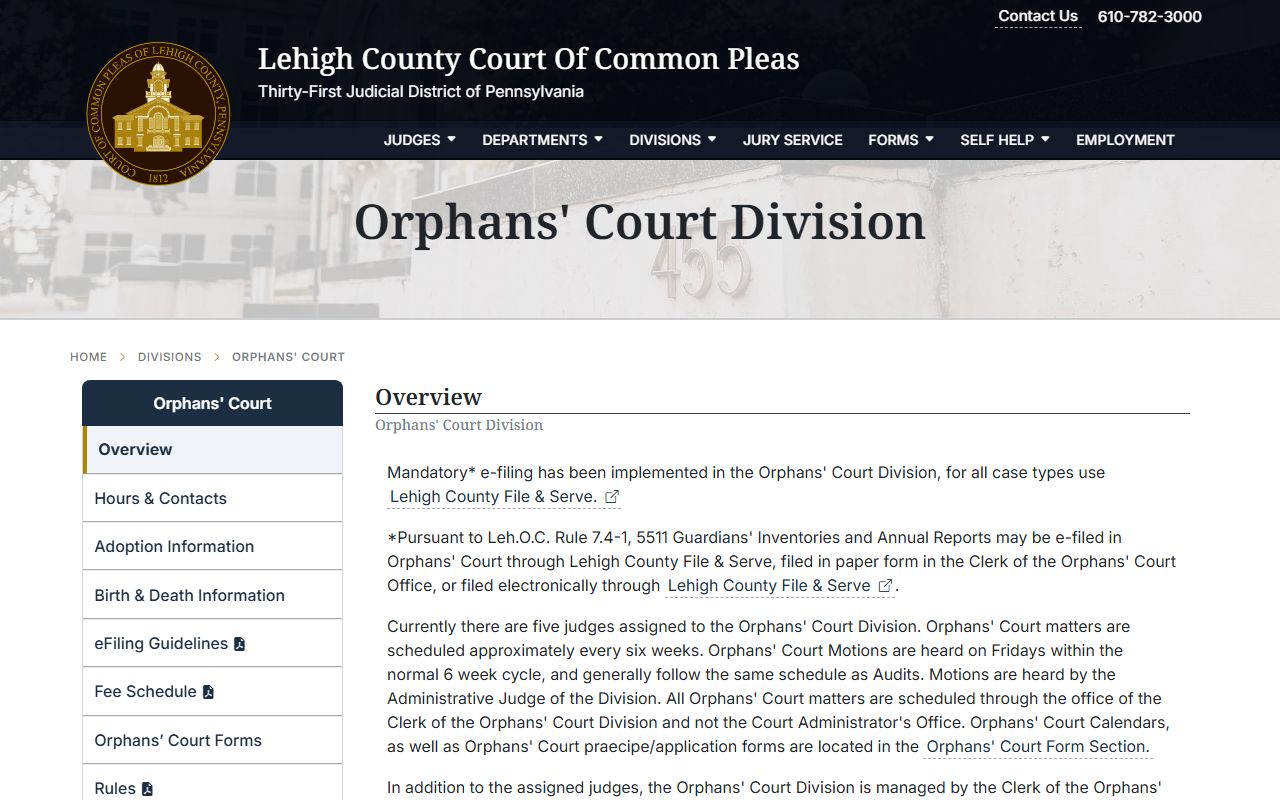
That page is a good first stop before you call or visit, since it names the division and its role. The Register of Wills, by contrast, is housed inside the consolidated Clerk of Judicial Records office.
Lehigh County Probate Terms Defined
Probate files use words you may not see day to day. A quick guide helps you read an estate docket and know what each filing means. These terms come up in most Lehigh County probate records.
- Testator
- The person who made the will. The will speaks for the testator after death.
- Executor
- The person named in a will to carry it out and settle the estate.
- Administrator
- The person the court names to handle an estate when there is no will or no executor serving.
- Intestate
- Dying without a valid will. State law then sets who inherits.
- Letters testamentary
- The court paper that gives an executor named in a will the authority to act.
- Letters of administration
- The court paper that gives an administrator authority when there is no valid will or no executor serving.
- Short certificate
- A probate certificate that shows the authority of a personal representative or fiduciary. Often requested from the Register of Wills.
- Guardianship
- A court order naming someone to make decisions for a minor or an incapacitated adult who cannot act on their own.
How to Search Lehigh County Orphans' Court Records
Register of Wills records in Lehigh County date back to 1812. That is a deep file. Newer records may show up on a computer, but the oldest ones do not. Public terminals sit inside the division so you can look up estates in person. The county's Odyssey and Online Records Access system can expose some records to account holders, but the search fields there are gated behind a login. For older, non-computerized files, you usually have to inspect them at the division unless a record is restricted.
If you want an estate that is decades old, plan to call first. Bring what you know about the decedent. A name and a rough date of death go a long way. The steps below outline a typical Lehigh County probate search.
- Gather the decedent's full name, the date of death, and the rough year the estate was probated.
- Check the county Online Records Access system to see if the estate appears online to your account.
- For older or non-computerized files, plan to use the public terminals or inspect records at the division in person.
- Call the Register of Wills with the name, date of death, and any known file number to confirm what exists.
- Ask whether you need a plain copy, a certified copy, an exemplified copy, or a short certificate, and which fee applies.
Note: The county warns that online data can lag, so the office is the place to confirm current case status and to get certified copies.
Probate Offices in Lehigh County
Two offices share the probate load, and both sit in downtown Allentown. The Register of Wills Division lives inside the Clerk of Judicial Records office in Room 122. Chief Deputy Diana L. Dergham leads that division, with Shannan Ianovale as Assistant Chief Deputy. The Orphans' Court Division is part of the Court of Common Pleas, and its Clerk keeps all Orphans' Court records. The two cards below give the lines you will most often need.
Register of Wills Division
455 West Hamilton Street, Room 122
Allentown, PA 18101-1614
610-782-3170
Fax: 610-871-2895
Clerk of Orphans' Court
455 West Hamilton Street
Allentown, PA 18101-1614
610-782-3172
Fax: 610-782-3928
The main court line is 610-782-3000 if you are not sure which division should take your call. The Register of Wills handles the probate and inheritance-tax side. The Orphans' Court handles the matters that need a judge.
Lehigh County Probate Filing Fees
Probate fees change over time, so always check the current schedule before you file or order copies. Lehigh County posts a "Filing Fees - 2026" link on the Register of Wills page, and that is the source you should trust. The table below lists older fee examples pulled from a prior official PDF. Treat them as examples to verify against the 2026 schedule, not as confirmed current fees.
| Item | Example Amount (verify against 2026 schedule) |
|---|---|
| Will lodged | $50 |
| Short certificate | $10 |
| Research fee | $20 |
Important: The amounts above are older examples only. Confirm every fee against the official Filing Fees - 2026 schedule linked from the Register of Wills page before you pay.
What Lehigh County Orphans' Court Records Show
An estate file builds up over time. It starts with the will and the petition for probate. Then come the letters that name the executor or administrator. An inventory lists the assets. An account reports what came in, what went out, and how the estate plans to pay out. Guardianship files follow a like path, with inventories and annual reports. A caveat may appear if someone challenges the probate. Appeals from Register of Wills actions and contested estate matters round out the heavier files.
Most new probate work is now filed by computer. The county made e-filing mandatory for Register of Wills case types on February 15, 2023, except as exempted. Orphans' Court case types went mandatory on or about April 1, 2023, again with exemptions. Guardians' inventories and annual reports under Orphans' Court Rule 7.4-1 and Section 5511 may be e-filed through Lehigh County File & Serve, filed on paper in the Clerk of the Orphans' Court Office, or filed through the same File & Serve system.
The File & Serve system runs on Tyler's platform. Attorneys handle most of the e-filing, but the public record that results is the same docket you can later look up. For broader case types, see court records.
Restricted Orphans' Court Records, Adoptions, and Minors
Not every Orphans' Court file is open to the public. Adoptions are handled by the Orphans' Court, but adoption court records and original birth records are sealed or impounded under Pennsylvania law and Department of Health procedures. Some guardianship and minor records are likewise restricted. Mental health records are precluded from public access by law, and child victim records are also kept out of public files. A case sealed by court order is not open for ordinary inspection. So do not treat every Orphans' Court file as something you can simply download.
Records that involve minors carry their own rules. Juvenile files are restricted under the Pennsylvania juvenile statutes and Unified Judicial System policy. Access may be limited to the parties, their counsel, the court, probation, law enforcement, certain agencies, or anyone the court allows by order. The first juvenile statute, 42 Pa.C.S. § 6307, sets who may inspect and copy a juvenile's files. You can read the text on the Pennsylvania statute page for 42 Pa.C.S. § 6307.
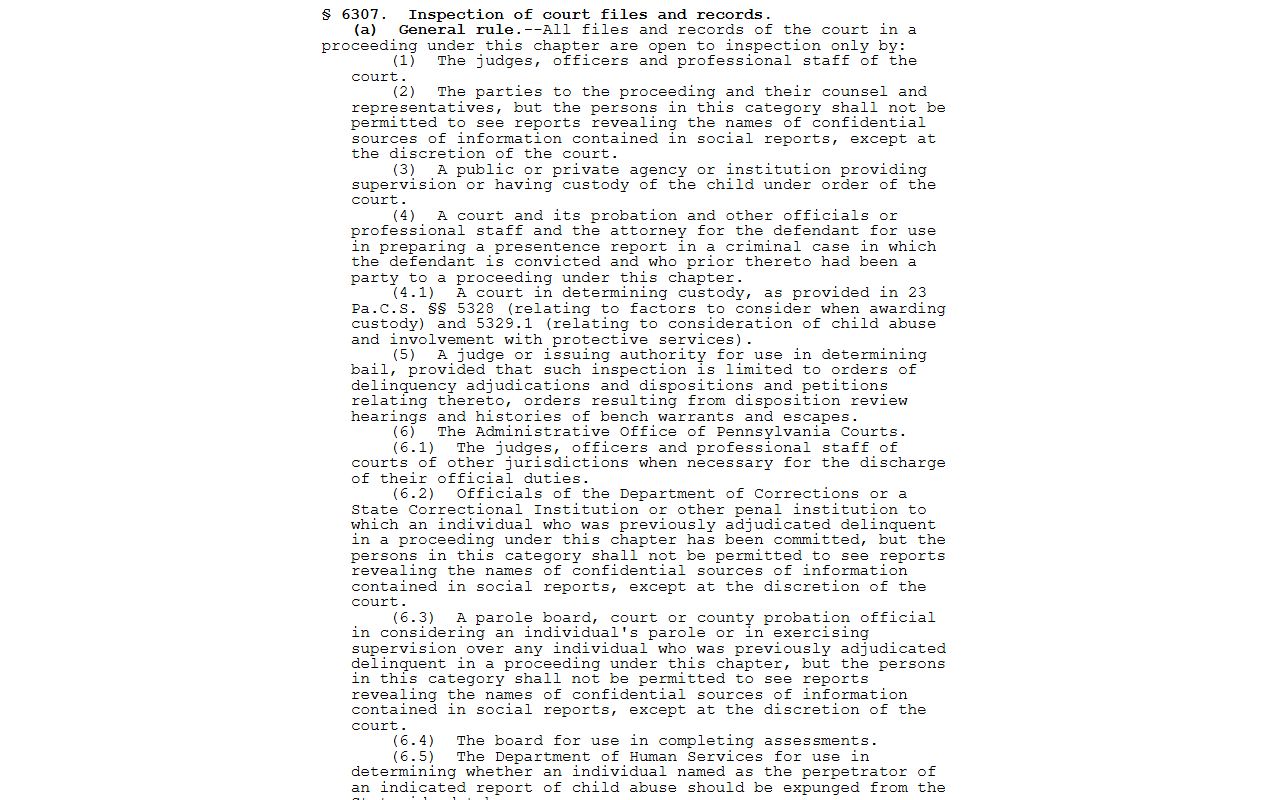
That section explains who has a right to see a juvenile file and when a court order is needed. A second statute deals with the official records of the court itself.
The companion section, 42 Pa.C.S. § 6308, governs the law enforcement records and files tied to juveniles. It controls how those records are kept and who can reach them. The full text sits on the Pennsylvania statute page for 42 Pa.C.S. § 6308.
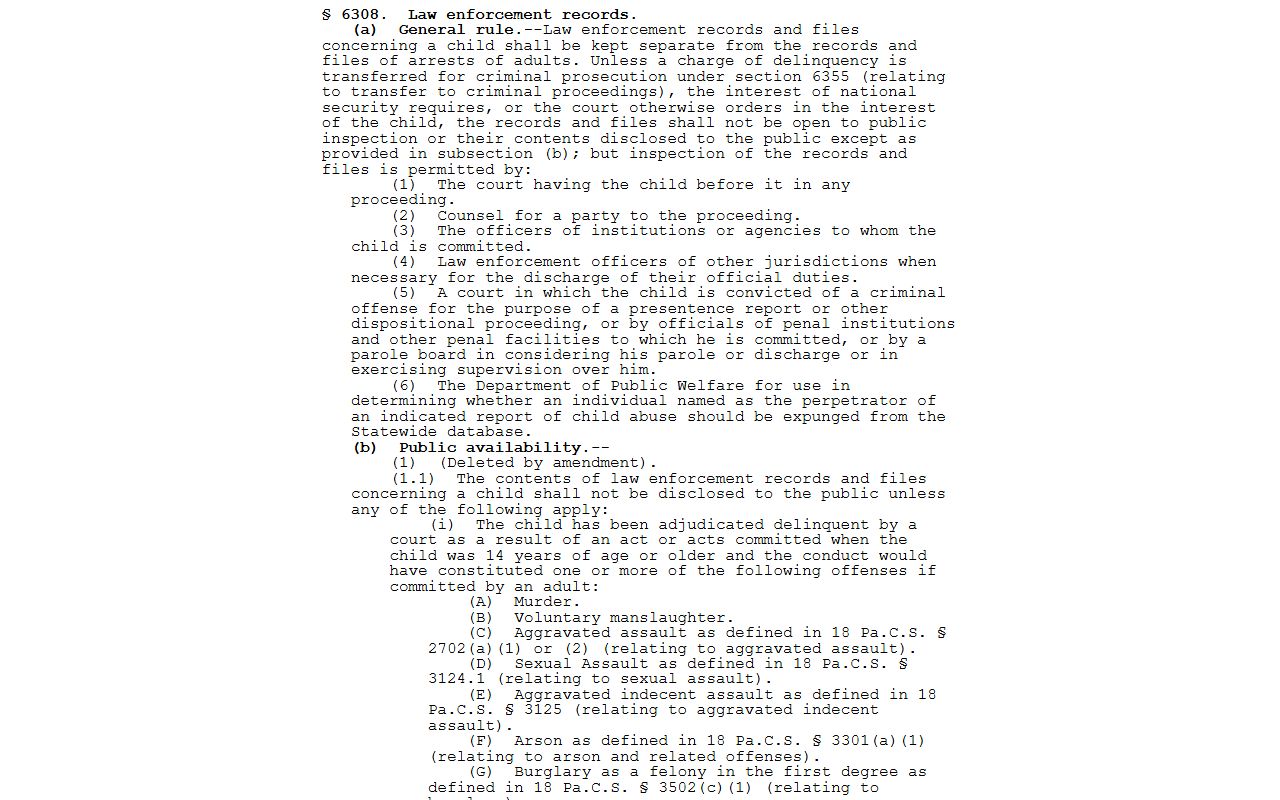
Read together, these two sections set the wall around juvenile and minor records that touch Orphans' Court adoption and guardianship work. When in doubt about a sealed file, ask the Clerk what access rule applies.