
About the Lehigh County Clerk's Office
The Lehigh County records officer is the Clerk of Judicial Records, Michelle Graupner. This is an elected post, not an appointed one. The office is not a plain clerk of courts in the usual sense. It pulls together work that many Pennsylvania counties split across separate offices. One office now answers for civil, criminal, and estate court records, plus county deeds. That single setup is the thing to remember before you call or visit.
The office maintains records for the Thirty-First Judicial District, which is the Lehigh County Court of Common Pleas. It dockets and indexes cases, scans files, collects fees, processes court orders, and transmits appeals to higher courts. The Clerk also runs the public terminals where anyone can review non-restricted files. All four divisions share one room in the courthouse, with a file review area next door.
Clerk of Judicial Records
Clerk: Michelle Graupner
455 W. Hamilton Street, Room 122
Allentown, PA 18101-1614
610-782-3148
Mon-Fri 8:00 a.m.-4:30 p.m.
How the Lehigh County Clerk Took Shape
The office looks the way it does because of two changes to the county's Home Rule Charter. Before 1978, Lehigh County had separate offices, such as the Clerk of Quarter Sessions and the Prothonotary. On January 1, 1978, the charter merged those into the Clerk of Courts, with a Civil Division and a Criminal Division. The second change came thirty years later.
On January 7, 2008, a charter amendment abolished and folded three offices into one. The Clerk of Courts, the Register of Wills, and the Recorder of Deeds all became the elected Clerk of Judicial Records. Andrea E. Naugle took office as the first Clerk of Judicial Records in January 2008. That is why one office now answers for court files, wills, and deeds. The county's own history page lays out the consolidation and the dates.
The county's Clerk of Judicial Records history page walks through the 1978 and 2008 changes and the record-coverage dates.
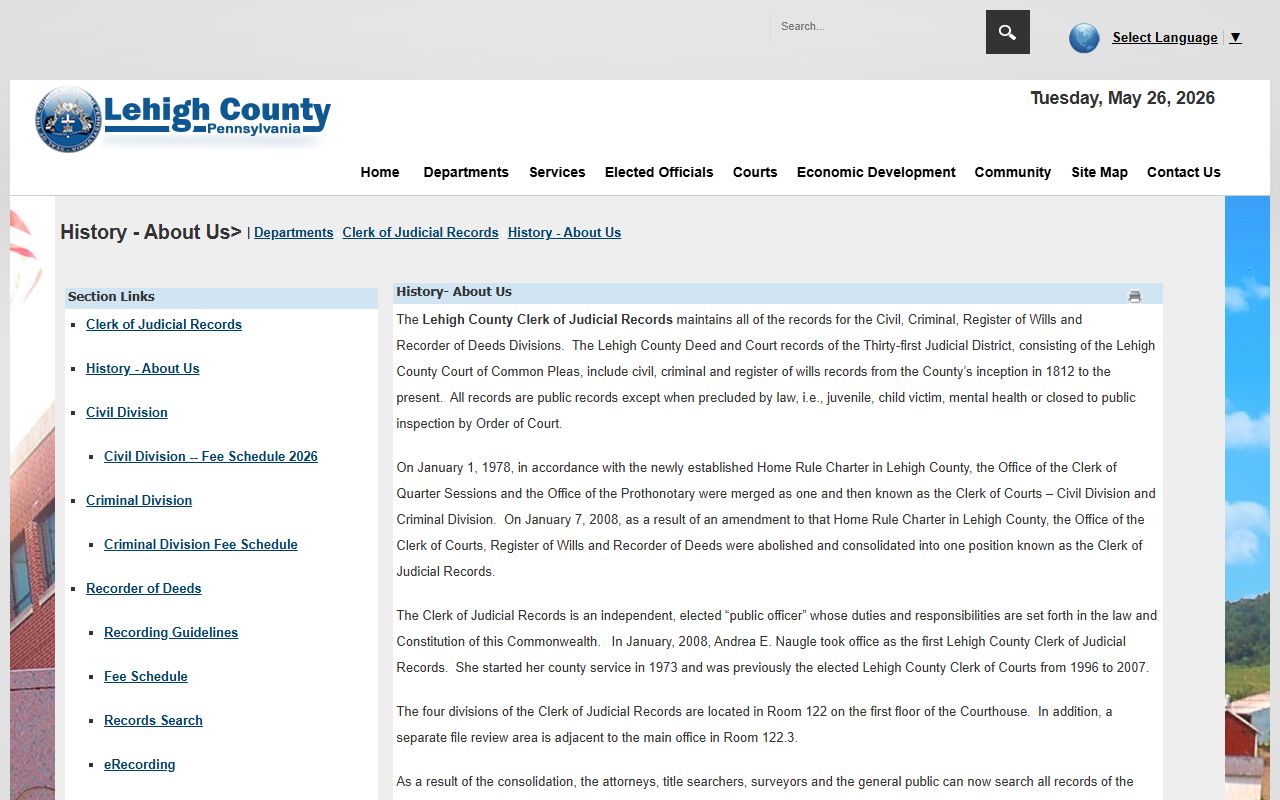
That page is also where the county states record coverage dates and confirms that public terminals sit in each division. It is the best single source for how this office came together.
Divisions of the Clerk of Judicial Records
The office runs four divisions, and each one handles a different record type. All four sit in Room 122. The Civil Division acts as the prothonotary and keeps civil and family case files. The Criminal Division keeps adult and juvenile criminal files and handles bail. The Register of Wills Division takes probate and inheritance-tax filings. The Recorder of Deeds Division keeps land records, though those are not court files.
Each division has its own direct phone line and its own chief deputies. The table below lays out the contact for each. Pick the division that matches the record you need before you call, since the staff in one division will not pull files from another.
| Division | Leads | Phone |
|---|---|---|
| Civil Division / Prothonotary | Chief Deputy Sayra Tineo; Asst. Chief Deputy Justine French | 610-782-3148 |
| Criminal Division | Chief Deputy Jill Herschman; Asst. Chief Deputy Catherine Ruth | 610-782-3077 |
| Register of Wills Division | Chief Deputy Diana L. Dergham; Asst. Chief Deputy Shannan Ianovale | 610-782-3170 |
| Recorder of Deeds Division | Land records, not court files | 610-782-3162 |
The Civil and Register of Wills divisions share a fax line at 610-871-2895. One note on bail: the Criminal Division takes cash only for monetary bail, so plan for that before you go in.
Civil Division and Prothonotary Records
The Civil Division does the work a prothonotary does in other Pennsylvania counties. It initiates civil case types and dockets, indexes, and scans civil cases, family court cases, judgments, notes, and liens. It processes court orders, collects and distributes funds, and transmits appeals. If you need a divorce file, a judgment, or a lien record, this is the division to call.
The county's Civil Division page lists the chief deputies and the division's duties.
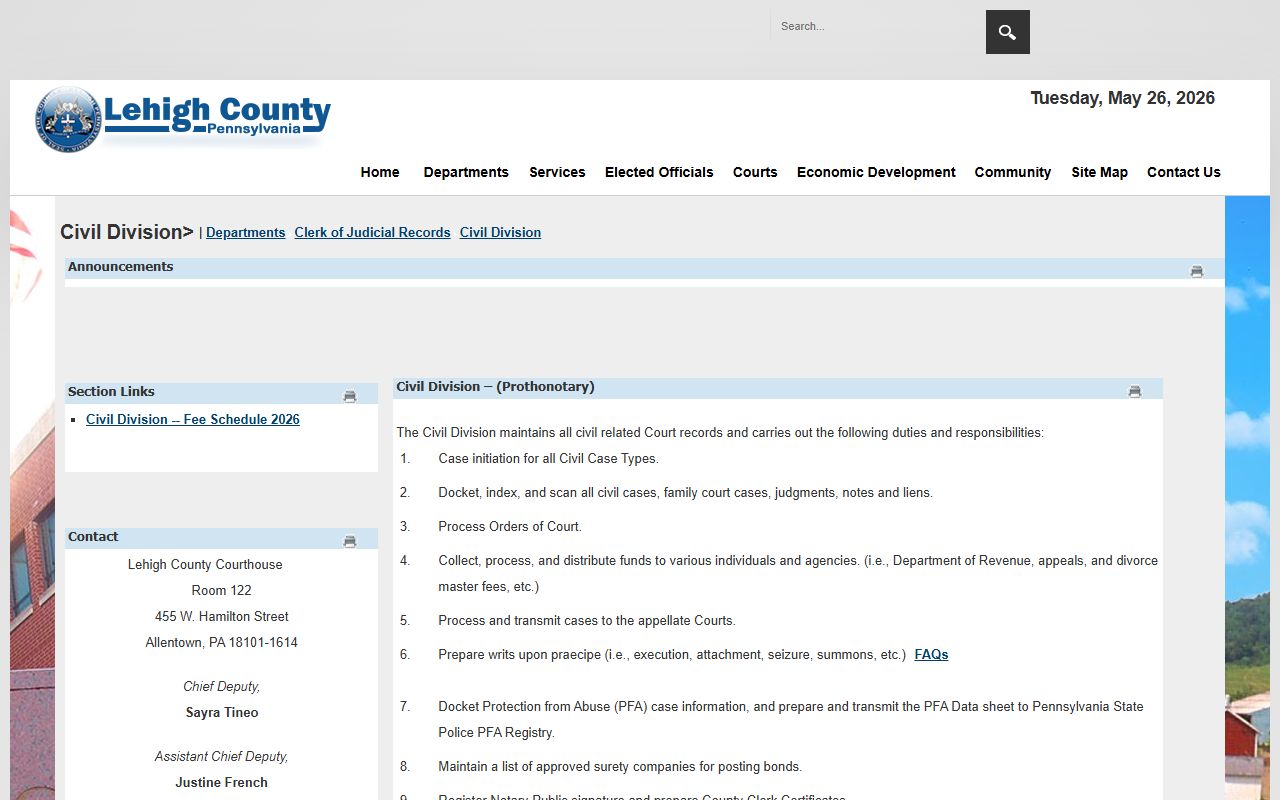
That page is the right starting point for civil filings, family cases, and the judgments and liens that the Civil Division keeps. For full case-search steps, see court records, and for how dockets read, see court dockets.
Criminal Division Records
The Criminal Division keeps criminal court records and processes adult and juvenile criminal matters. It collects bail, issues and distributes refunds, and keeps bail-bond agency records. It also accepts and processes appeals to higher courts. The county page lists a separate email for criminal document requests, which is the better route for copies of charging documents or orders.
You can see the staff and duties on the county's Criminal Division page.
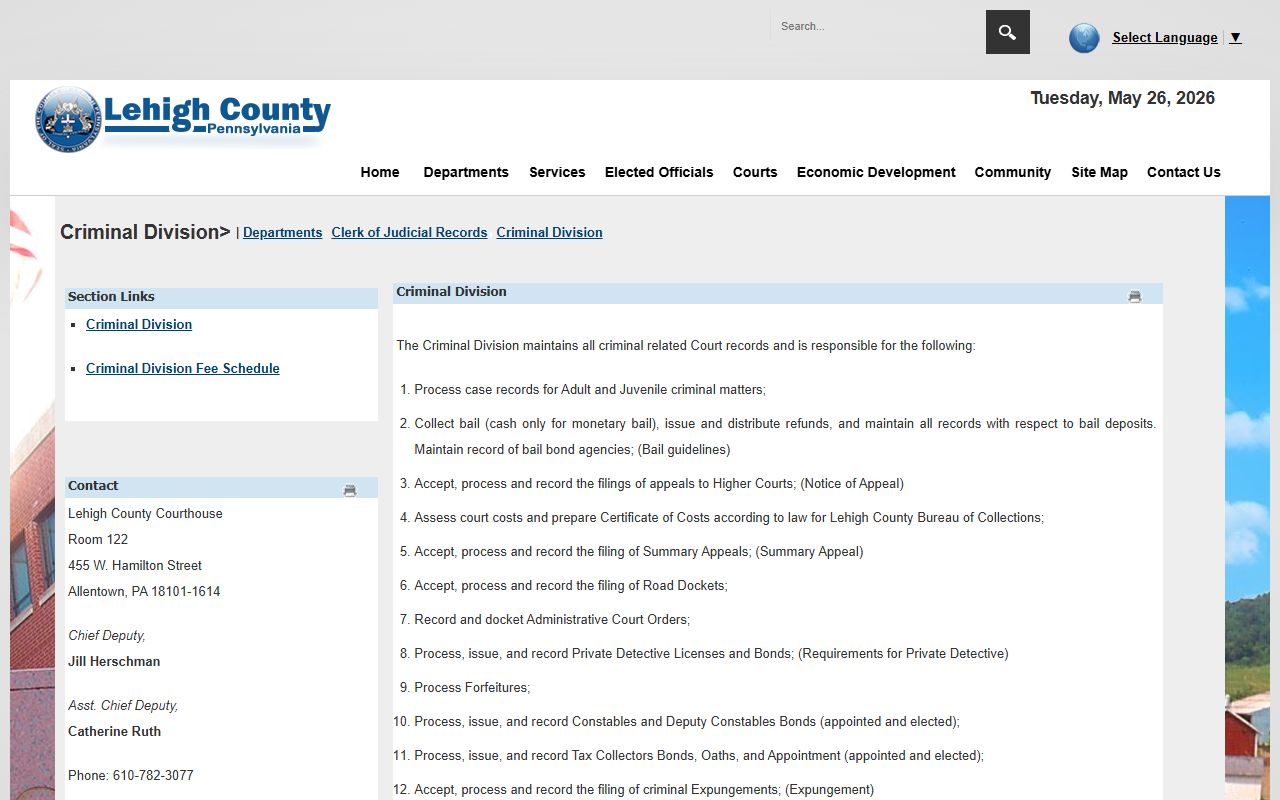
Remember the cash-only rule for monetary bail when you deal with this division. For records that begin with an arrest, see arrest records.
Register of Wills Division
The Register of Wills Division handles probate, inheritance-tax records, and related estate filings. This is where an estate starts. Contested estate matters, guardianships, trusts, and adoptions move on to the Orphans' Court Division of the Court of Common Pleas. So the Register of Wills opens the estate, and the Orphans' Court hears the disputes. The two work side by side.
The county's Register of Wills page lists the chief deputies and links the filing-fee schedule.
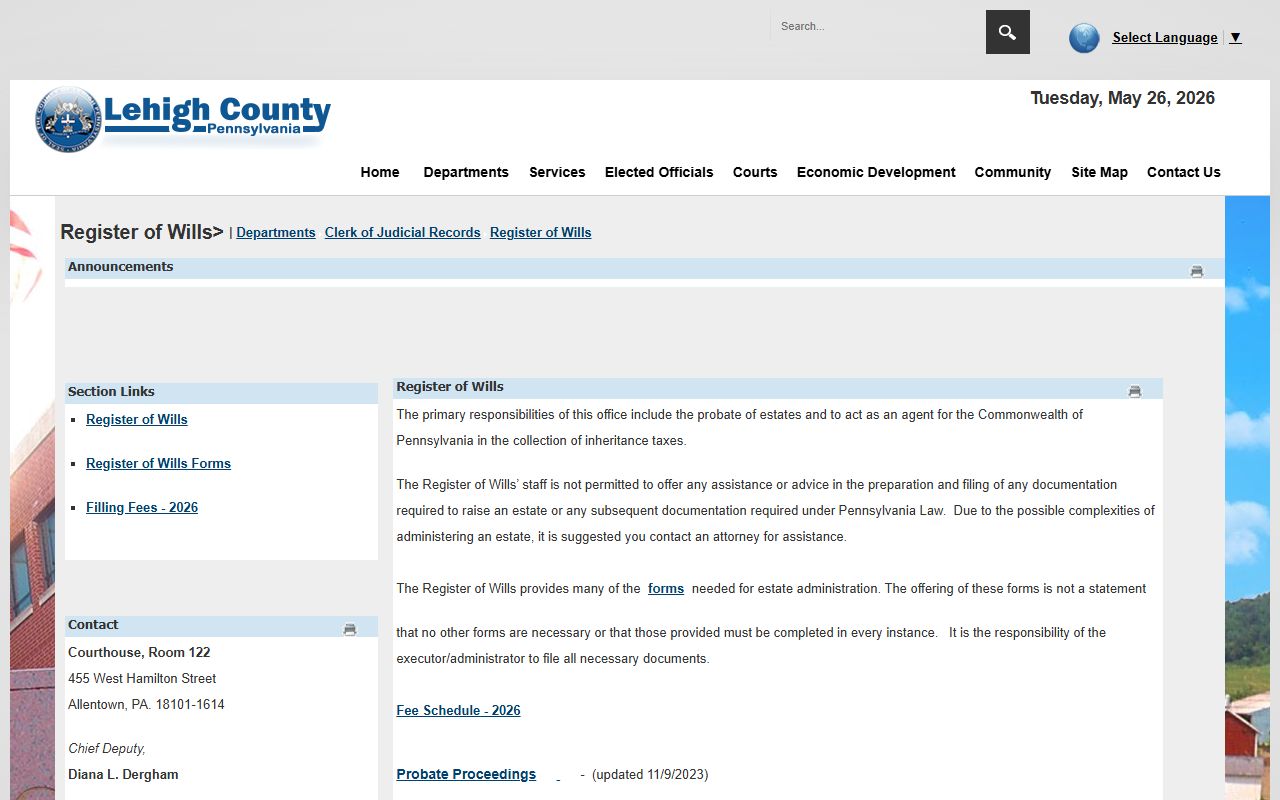
For estate steps, fees, and forms, see Orphans' Court records. For marriage licenses, which are also issued near this division, see marriage and divorce records.
What Records the Clerk Holds
Coverage reaches back to the county's start in 1812, but the dates differ by record type and by format. The county states that deed and court records of the Thirty-First Judicial District include civil, criminal, and register of wills records from 1812 to present. Computer coverage is newer than paper coverage. Older files still exist in paper, microfilm, or docket-book form, and they remain open for public inspection in each division.
- Civil records: computerized back to 1985.
- Criminal records: computerized back to 1990, with index notes to 1962.
- Register of Wills records: back to 1812.
- Recorder of Deeds: image records to 1957, with index information to 1812.
Records are public except where the law says otherwise. The county names juvenile records, child victim records, mental health records, and any case closed by court order as the main exceptions. Sealed and expunged matters also drop out of the public view.
How to Request a Certified Copy
A certified copy carries the Clerk's seal and proves a court record is true. Courts, agencies, and other states ask for certified copies when a plain printout will not do. The steps below follow the county's court record request workflow.
- Search the Pennsylvania UJS Case Search to find the docket number and court level for the file you want.
- Pick the right division: Civil at 610-782-3148 for civil and family, Criminal at 610-782-3077 for criminal, or Register of Wills at 610-782-3170 for probate.
- Ask whether the file is computerized, scanned, on microfilm, in a docket book, or in the non-computerized archive.
- Tell the division what you need: a plain copy, a certified copy, an exemplified copy, or a docket sheet.
- Confirm the fee, the payment method, and the processing time before you mail a request or visit in person.
For purely informational use, a plain copy or a free docket sheet may be enough. Save the certified copy for legal use, where the seal is required.
Records Request Details to Include
Whether you call, write, or visit, the division needs enough detail to find the right file. A docket number is the fastest path. If you do not have one, a full name plus a filing year helps the staff narrow a common name. The fields below are the details to have ready before you reach out.
| Field | Required | Notes |
|---|---|---|
| Docket / Case Number | Helpful | Found through UJS Case Search; fastest way to pull a file. |
| Party Names | Yes | Full legal names; add a filing year for common surnames. |
| Division | Yes | Civil, Criminal, or Register of Wills, based on the case type. |
| Document Type | Yes | Plain copy, certified copy, exemplified copy, or docket sheet. |
| Number of Copies | Yes | Each certified copy carries its own fee. |
Note: court staff can pull and copy records, but they cannot give legal advice or tell you which document you need for a case.
Lehigh County Clerk Fees
Fees depend on the division and on the kind of copy. The numbers below are the ones confirmed in official county and state sources. Each division also posts a full 2026 fee schedule PDF on its own page, so check the Civil, Criminal, or Register of Wills page to verify exact line-item filing and copy fees before you send money.
| Item | Amount |
|---|---|
| Marriage license application (includes two certified copies) | $100 |
| Additional certified marriage copy | $10 each |
| UJS financial-record photocopies (11+ pages) | $0.15 per page |
| UJS financial records on CD | $5 each |
Card payments at the Marriage License Office add a 2.9% service fee on top of the listed amount.
Online and Attorney Access
The Clerk supports online access for many records, but the public-facing tools differ from the gated ones. Lehigh County Odyssey Public Access lets registered users sign in and view case data, though the data runs only through the end of the prior business day. For current case status, the county tells searchers to use the Civil Division in Room 122 during office hours. The county also runs a gated Attorney Docket Access tool for attorneys and ORA users under a user agreement.
You can read the sign-up and data-currency notice on the Odyssey Public Access page, and the gated Attorney Docket Access page lists the e-filing mandates. For the free statewide docket portal, see court records.