
How to Find Recently Released Lehigh County Inmates
There is no county portal that prints a daily list of who left the Lehigh County Jail. The county pages do not host a public jail roster or a released-inmate search form. That means you cannot simply type a name into a county site and get a release date. Instead, you confirm a release by working through a short hierarchy of official sources, starting with the jail itself and moving out to state and federal systems if the person was held at that level.
Begin with the jail. The records line is the fastest way to confirm a status for someone held at the county level. Have details ready before you call. A full legal name helps. A date of birth helps more. If you know the approximate arrest date, the arresting agency, or a docket number, share it. Staff handle many requests, so clear information saves time on both ends.
The verify-a-release steps below cover the main paths in order. Most county-jail questions get answered in the first two or three. State and federal lookups only apply when the person moved to that system.
- Call the Lehigh County Jail records line at 610-782-3263, or general information at 610-782-3270, to confirm a county status.
- Register with PA SAVIN through VINELink so you get a phone or email alert on release, transfer, or escape.
- Check the Pennsylvania UJS Case Search for docket entries that show bail action, a court-ordered release, or a disposition.
- Use the PA Department of Corrections locator if the person was sentenced to a state prison or is on state parole.
- Use the Federal Bureau of Prisons locator if the case was federal.
A court docket often shows why a release happened. You can read filings, bail entries, and orders through UJS Case Search at no cost. The docket will not say "released today," but a posted bail or a final order tells you a lot. For the day-to-day jail status itself, the phone call still wins.
Setting Up Release Notifications
The cleanest way to learn about a release is to let the system tell you. Pennsylvania runs a free service called PA SAVIN. It can call, email, text, or send an app alert when an offender is released, transferred to another facility, or escapes. You sign up once and then wait. This is the route the District Attorney's Victim and Witness Unit points crime victims toward, and it works for family members too.
You register through VINELink, the official SAVIN partner. The state explains the program on its own service page. You can read how the notifications work and start the sign-up at the Pennsylvania offender release notification page.
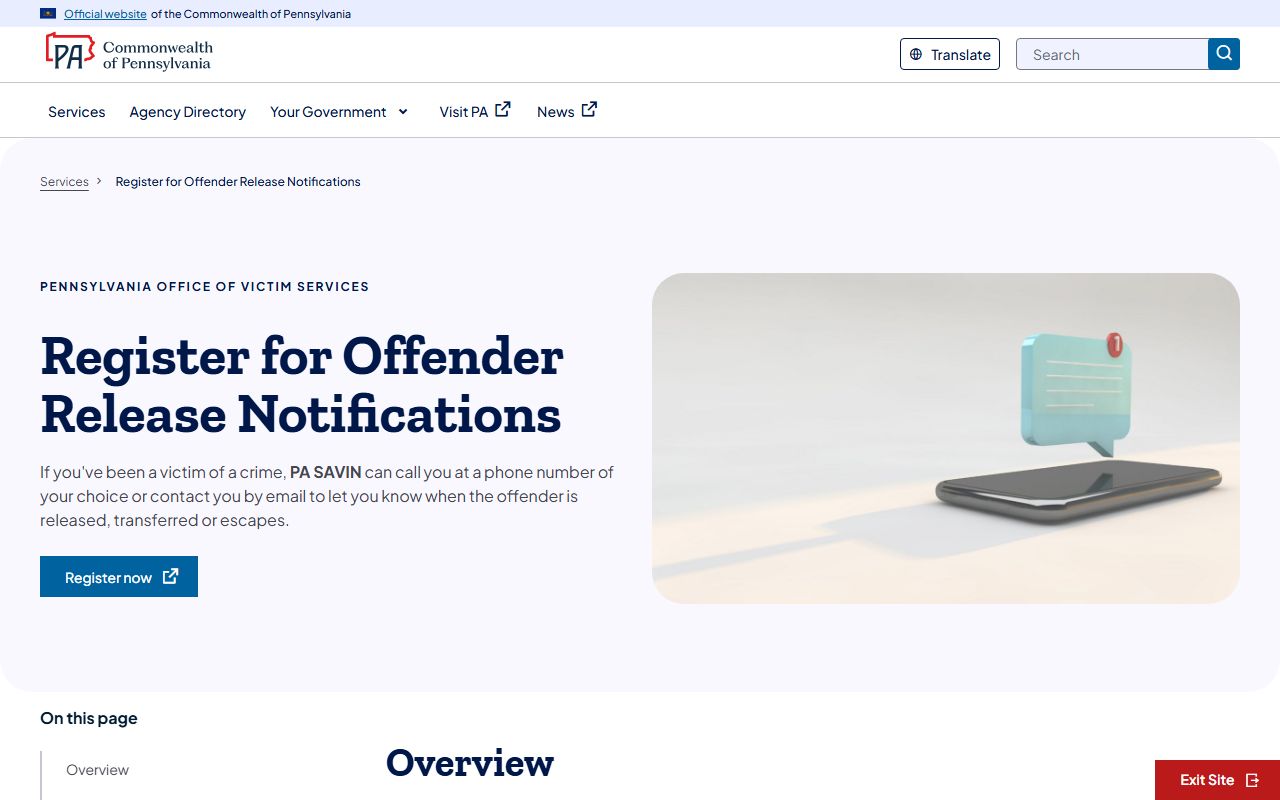
That page sends you to the registration tool and lists the contact options for alerts. If your phone number or email ever changes, you have to update the registration, or the alert may not reach you.
VINELink is where you actually search and enroll. It is the official notification site, not a data broker. Start at VINELink and pick Pennsylvania, then search by name.
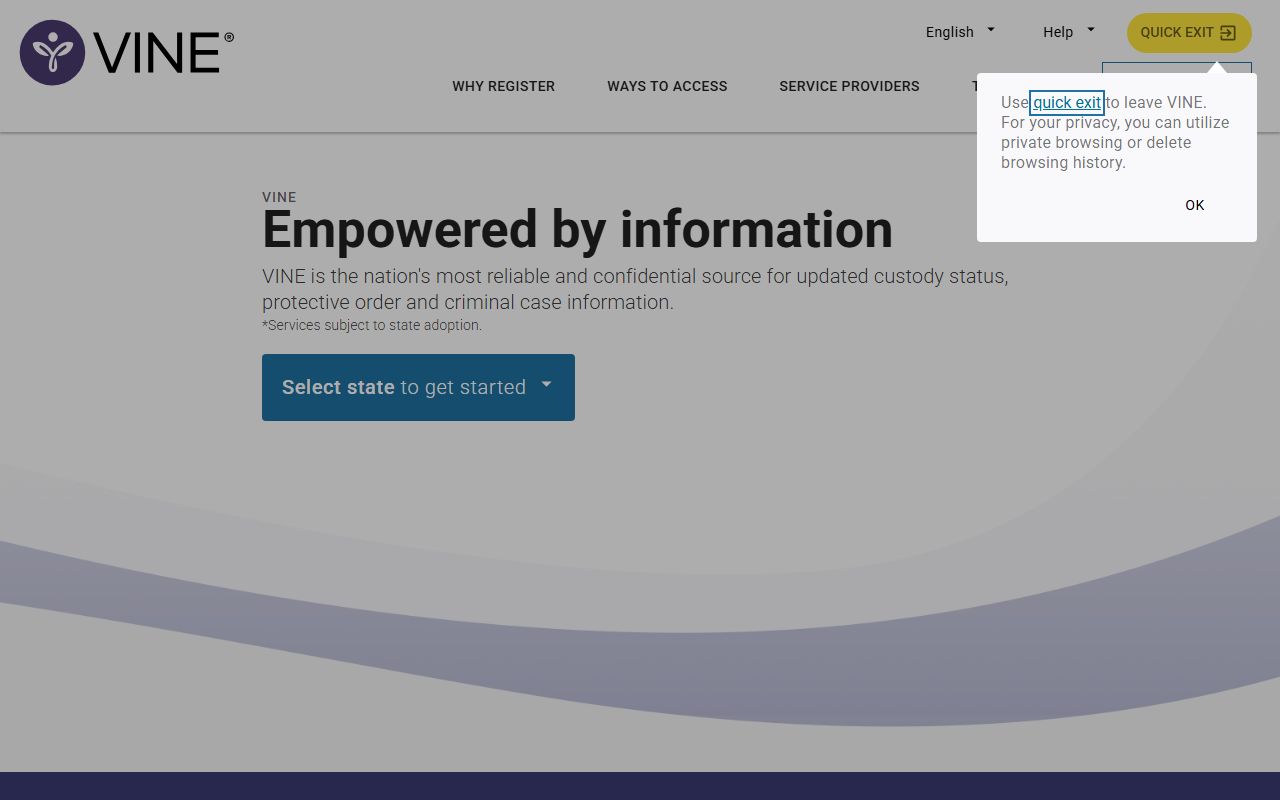
From that screen you set how you want to be reached. The steps below show the basic flow.
- Open VINELink and select Pennsylvania as the state.
- Search by the offender's first and last name to find the record.
- Register for alerts by phone, email, text, or the mobile app, and confirm your contact details.
You can also enroll by phone. Call 1-866-972-7284 to set up notifications without going online. The VINELink app does the same job on a smartphone. Note: PA SAVIN tells you when a status changes, but it is not a full jail roster and does not replace a records-line call for a same-day answer.
Searching the Pennsylvania Department of Corrections
State prison is not the same as county jail. The Lehigh County Jail holds people awaiting trial and those serving shorter local terms. When a court sentences someone to a longer term, they go to a Pennsylvania state prison run by the Department of Corrections. If your person was sentenced to state time or is on state parole, you search the DOC locator, not the county.
The state is direct about one limit. County facility inmates cannot be found through the state locator. So if a search comes back empty, that may simply mean the person is still at the county level, where the jail records line is the right call. The DOC tool covers state-sentenced inmates and parolees only.
The locator keeps the search simple. You can look someone up by last name alone or by their inmate number. A first name helps when the last name is common. The table lays out the fields.
| Field Label | Type | Required | Notes |
|---|---|---|---|
| Last name | Text | Yes unless inmate number used | The state says you can search by last name or by inmate number. |
| Inmate number | Text | Yes unless last name used | For state-sentenced inmates and parolees. |
| First name | Text | No | Helpful for common last names. |
| Search | Button | Yes | Disable pop-up blockers; try another browser if the result does not load. |
The DOC also runs a parolee locator, which can help when someone left state prison and is now under supervision in the community. That is the tool to use when you are tracking a state release rather than a county one.
Federal Bureau of Prisons Locator
Some cases are federal, not state or county. Federal charges are handled in U.S. District Court and federal custody runs through the Bureau of Prisons. If the case was federal, neither the county jail nor the state DOC will show it. You search the BOP instead. Its free locator covers federal inmates from 1982 to the present, including release dates for people who have left federal custody.
You can find someone by number or by name. The number search accepts a BOP Register Number, a DCDC number, an FBI number, or an INS number. The name search lets you add race, age, and sex to narrow a long list. Use the BOP inmate locator to run the check.
| Field Label | Type | Required | Notes |
|---|---|---|---|
| Find By Number | Tab / radio | No | BOP Register Number, DCDC, FBI, or INS Number. |
| Number | Text | Yes for number search | Enter the exact identifier. |
| Find By Name | Tab / radio | No | Name search for federal inmates from 1982 to present. |
| First Name | Text | No | Paired with last name. |
| Last Name | Text | Yes for name search | Main field for a name lookup. |
| Race / Age / Sex | Dropdown / number | No | Narrows results for common names. |
If the BOP result shows a release date, that person is out of federal custody. Just keep in mind they could still face state or county matters in Pennsylvania, which is why a docket check can fill in the rest of the picture.
Verifying Release in Person or By Phone
For a county-jail question, the phone is still the most reliable tool. The records line at the Lehigh County Jail handles status and records requests, and the general information line can route other questions. Calling beats guessing from an out-of-date website. Have the person's full legal name and date of birth ready, plus any arrest date or docket number you have.
Why does a release happen in the first place? Knowing the trigger helps you ask the right question. Common reasons include posting bail, charges being dismissed, a sentence being served out, a court order, a transfer to another facility, a transfer up to state prison, or a hold on a detainer. A detainer means another agency has asked the jail to keep the person, so a "release" from one case may not mean the person walks free.
The contact card below has the records line and the jail's address for in-person questions. The Criminal Division of the Clerk of Judicial Records handles cash bail and refunds, so bail questions may route there.
Lehigh County Jail Records
38 North Fourth Street
Allentown, PA 18102
Records: 610-782-3263
General info: 610-782-3270
Note: a release confirmed by phone is current; a website may lag, so trust the records line for same-day status.
Pennsylvania Megan's Law Registry
People sometimes look to the sex offender registry to track a release, but that is not what it does. Pennsylvania's Megan's Law registry lists people who are required to register because of certain offenses. It shows where a registered offender lives or works. It is not a jail roster and it does not list who got out of the Lehigh County Jail. Still, for the narrow set of people who must register, it can confirm that someone is back in the community and where.
You can search the registry by name or by county, including Lehigh. Location searches by municipality, city, or ZIP code are also possible, and you can set a mile radius around an address. Filters exist for transient, non-compliant, and sexually violent predator status. Confirm the exact checkbox labels on the live site.
| Field Label | Type | Required | Notes |
|---|---|---|---|
| Name Search | Tab / search mode | No | Search by offender name. |
| County Search | Tab / search mode | No | Search by county, including Lehigh. |
| Municipality / City / ZIP | Text | No | Location-based searching. |
| Mile Radius | Dropdown / number | No | Radius search around an address or ZIP. |
| Transient / Non-compliant / SVP | Filter | No | Status filters; verify exact labels live. |
A registry profile usually shows a name and aliases, a photo, registration and compliance status, an address or transient status, the municipality and ZIP, and offense details. A tier or category may show too. Employment, school, or vehicle data appears when the law allows it to be published.
Parole and Probation Information
Not every release is a clean exit. Many people leave custody under supervision. Probation is set by the court and often runs in place of, or after, jail time. Parole is supervised release from a prison sentence. The two are run by different offices depending on whether the case was county or state. For county cases, Lehigh County Adult Probation oversees supervision and reports problems back to the Court of Common Pleas.
For state cases, supervision is handled by the Pennsylvania Department of Corrections, which absorbed the old Board of Probation and Parole. The DOC parolee locator can confirm that someone left state prison and is now on supervision in the community. A parole violation can send a person back into custody, which is one reason a release status can change quickly.
Note: a person can be "released" from one case and still be held on another, so always confirm the full picture through the docket and the jail.
Reentry Resources in Lehigh County
Leaving custody is the start of a hard stretch for many people. Lehigh County and the state offer a few official supports that connect to reentry. They are not a full social-services list, but they are real places to start. The county runs the Community Corrections Center, a 400-bed facility for sentenced individuals. It gives an alternative to secure confinement, with rehabilitative programs, work release, community work, and structured use of community resources.
Legal help matters during reentry, since old cases, fines, and records issues can follow a person. The Public Defender represents people who cannot afford a lawyer in their criminal matters. For civil legal problems like housing, benefits, or family law, North Penn Legal Services offers free help to those who qualify. The Lehigh County Bar Association runs a lawyer referral service for people who need to hire counsel.
- Community Corrections Center: a 400-bed county facility with programs, work release, and community resources for sentenced individuals.
- Lehigh County Public Defender: criminal defense for people who cannot afford a private lawyer.
- North Penn Legal Services: free civil legal aid for those who meet income limits.
- PA DOC parolee locator: confirms state supervision status after a prison release.
Treatment and programming inside the jail also tie into reentry planning. For anyone tracking a release, these are the official threads to follow rather than unverified third-party halfway-house lists.
Civil Rights Restoration After Release
A release does not by itself wipe a record clean, and it does not always restore every right at the same moment. Voting is the right people ask about most. In Pennsylvania, a person serving a felony sentence behind bars cannot vote while confined. After release from incarceration for a felony, voting rights are generally restored. Pretrial detainees and many people held on misdemeanors may keep the right to vote even while in custody.
Because the rules turn on the type of conviction and the stage of the case, you should verify your own situation with the Pennsylvania Department of State before you rely on it. Re-registering to vote may be needed after a release. Other rights, like firearm rights, follow separate state and federal rules and are not restored automatically by leaving jail.
Employment is another common worry. A criminal record can show up in background checks, and some old cases can be sealed or expunged under Pennsylvania law. Those are court processes, handled through the same courts that hold the case file. A docket review is a sensible first step before any rights or record question.